How Spacecraft Fly
  • Home
  • About the author
  • What's it all about?
  • Reviews
  • Picture gallery
  • External links
  • Contact me
  • Author's blog
  • Correction to text

A visit to the European Space Agency’s Technical HQ

2/4/2014

3 Comments

 
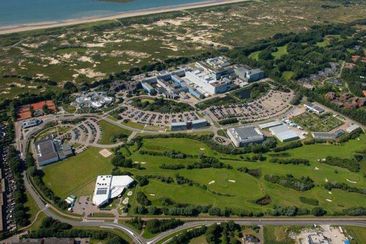
PictureAerial view of ESA Estec, Noorwijk, The Netherlands
The European Space Research and Technology Centre (Estec for short) is located in the Netherlands, on the North Sea coast near the holiday town of Noordwijk aan Zee.  As I
mention in the book – How Spacecraft
Fly
– I have been visiting Estec several times a year over the last 30 years or so, during my working life in both industry and academia. 
In fact the first thing I did when I joined the University of Southampton in 1987 was to lecture on the first Space Systems Engineering short course, run by the University on site in Holland. 
Subsequently in 1990 I took on the management and organisation (as well as lecturing of course) of the ESA short course programme until my retirement in 2010. However, I still do the odd few days lecturing for the University at Estec, and that’s because it’s fun and because they pay me well!  As my wife Marion is fond of saying – ‘old academics never die, they just loose their faculties’!   Not sure if that joke translates into other languages …?

Estec occupies a large area on the coastal dunes, with a workforce of about 2,500 engineers, scientists and support staff.  ESA is an organisation with 20 members states from across Europe, and each of these countries are represented in the Estec staff (although the official languages of the Agency are French and English).  ESA also dominates and drives European space activities – this involves proposing and managing large cutting-edge space projects, mostly in the applications of Earth observation and science.  Science is mostly about orbiting
observatories (such as ISO, XMM Newton, Planck, Herschel and Gaia) or robotic planetary explorers (such as Magellan, Cassini-Huygens, Rosetta and Bepi Colombo).  If you are not familiar with these projects, then google them.  Clearly there are lot of spacecraft in their in-flight phase, and these are controlled and operated by the ESA team at the European Space Operations Centre (ESOC) in Darmstadt, Germany.  But then there are many spacecraft in the build and test phase, and others at the proposal phase.  Estec staff spend a significant proportion of their working life interfacing with, and monitoring industry, particularly when spacecraft are
being designed, manufactured, assembled and tested.  Obviously there is a lot of commercial space activity going on in Europe (mostly in the area of space communications), and ESA often does not have a direct involvement in this, although a lot of European space technology has ‘spun-out’ from ESA projects into the commercial sector.

The Agency operates a system of ‘juste retour’ in its dealings with European industry.   In other words, each member state pays in a monetary contribution to the Agency and then receives, in return, work to its industry in proportion to its contribution.  So the more you pay in, the more work you get back.  For most member states, with a well developed and capable space industry, this arrangement works well.  But sometimes the politics of juste retour can be problematic for member states with industrial capabilities which are not so well developed.  
Then the politics can lead to situations where highly specialised tasks can be assigned to companies which are ill-equipped to cope with them.  Clearly this is an unusual circumstance, but the policy does sometimes create problems which need to be handled sensitively.  Historically, one of the reasons why Estec is located in the Netherlands is that at the time it was established (1968), there was a mismatch between the Netherland’s
contribution to the agency, and the size of the country’s space industry – at the time Holland’s space industry was too small to sustain the level of work returned under the policy.  So ESA’s technical HQ was sited in the Netherlands in compensation.
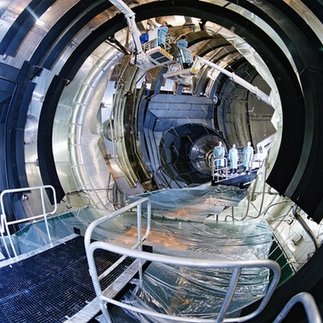
PictureThe LSS - ESA Estec Test Centre
I visited ESA Estec recently to do a few lectures on a short course run by the University of Southampton.  It was a course on the ‘Basics of Space Systems for Administrative Staff’, and my presentations covered orbits, launchers, attitude control and spacecraft subsystems (so that’s Chapters 1 to 5, and then Chapters 7 to 9 of the book!).  Training your non-technical staff in
this way is a very enlightened (and rare) training strategy, helping the support staff to understand more thoroughly the business in which they are involved.  On this visit I also had the opportunity to visit the Estec Test Centre, which has the largest and most impressive test facilities in Europe.  These facilities include:
-    TheLarge Space Simulator (LSS).   This is a very large chamber (see picture) which simulates the vacuum and
cold of space, as well as the heat of the Sun.
-   Various shakers to emulate the vibration and shock of the launch vehicle on its ‘rough ride’ to orbit – the largest shaker takes hardware up to 10 tonnes in mass.
-   Chambers in which the communications capabilities of spacecraft are tested.
-   The Large European Acoustic Facility (LEAF).  This is basically a bunker in which the unimaginably intense acoustic field of the launch vehicle is reproduced, to determine whether a spacecraft can endure this without causing damage.
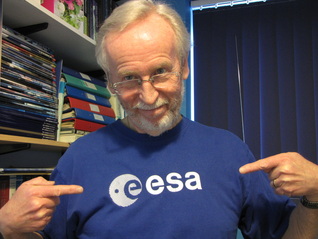
PictureThe author wearing his ESA fan T shirt!
During many such visits, over the years, it has been amazing to see the flight hardware of many large ESA spacecraft in the Test Centre clean rooms.  However, this time most of  the clean rooms and facilities were off limits, as classified testing work was taking place as part of the Galileo project – Galileo is a European satnav
system, which is an enhanced version of the US Navstar GPS.

Finally, having said all that, I do wonder how many of the
projects that I have mentioned are familiar to you?  Over the years ESA has done amazing things – for example, soft landing a probe on Titan (the largest moon of Saturn)and orbiting an observatory with the largest aperture.  Now we have the promise of the Rosetta project, the goal of which is to rendezvous with, and land on a comet during the coming year.  Although I am a great fan of ESA, one issue that I have is that they are generally poor at public relations.  When NASA achieves some great feat of space engineering or science, everybody knows about it.  However, when you look at ESA’s amazing record of achievements, who knows about them? Come on ESA!  Wake up ‘blow your own trumpet’ – very loudly!

3 Comments

Blessing

1/25/2014

1 Comment

 
Picture
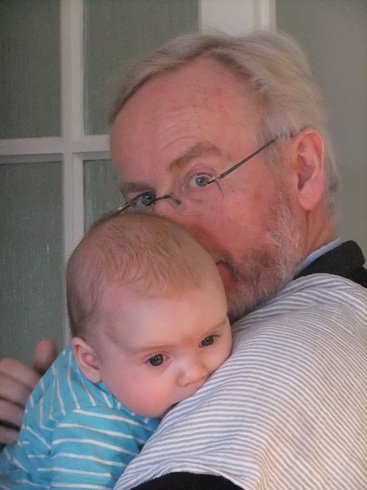
This post has not much to do with space, except that I’m over the moon with the birth of our first grandchild.  

My son Jamie and his wife Emily have been blessed with a son – Fred Michael – who is truly a little
ray of sunshine!  Apologies to my usual readers who probably expect me to be rattling on about space, but he is a
little star!  :)


1 Comment

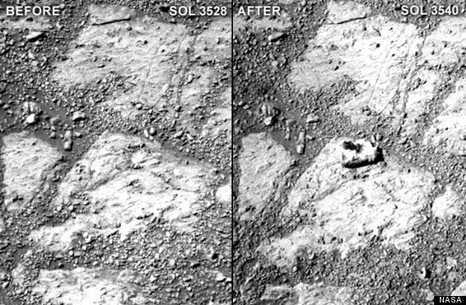
Mystery rock ‘materialises’ in front of Opportunity rover.

1/23/2014

0 Comments

 
Picture
NASA scientists are mystified by the appearance of a rock on the Martian surface that wasn’t there last time Opportunity rover passed by.  
 
Opportunity landed on Mars in January 2004 with an anticipated 3 month mission lifetime.  Ten years later it is still roving, and exploring the Martian surface. 
The second of the two images shown, in which the rock appears, was taken about 12 Martian days (each of 24 hours 39 mins) after the first.  At first I thought this was a hoax, but the truth of the matter is revealed on NASA’s Opportunity website:
 http://marsrovers.jpl.nasa.gov/mission/status.html#opportunity.

The ground operations team were genuinely surprised by the ‘sudden’ appearance of the rock, where there was none beforehand. Possible theories being suggested were that the rover may have flipped the rock into its new position as it passed by, or that it had just landed there after a meteorite impact nearby. Clearly there were other
ideas such as little green men (or Elvis?) throwing stones at the intruder.  Whatever the cause, NASA scientists now consider the rock worthy of further scientific scrutiny.

0 Comments

Venus shows beautiful crescent in the evening twilight

1/4/2014

0 Comments

 
Over the last few months, Venus has been a very bright object in the evening twilight, but you may be forgiven for not noticing it (if you are UK observer) as it has been very close the the Western horizon for most of that time.  So, although it has been shining brightly, it has appeared against a twilit sky and also setting soon after the Sun.

Just now it is about to overtake the Earth on the 'inside track' in its orbit, so its evening sky apparition is about to end with 'Inferior Conjunction' on the 11 January 2014, when it will be directly between the Earth and the Sun. At the time of writing, it still shines brightly in the evening twilight, but it is rapidly getting closer to the Sun so it will soon be lost in the evening twilight.  After the 11th it will eventually establish itself (by the end of January) as a brlliant object in the pre-dawn sky.

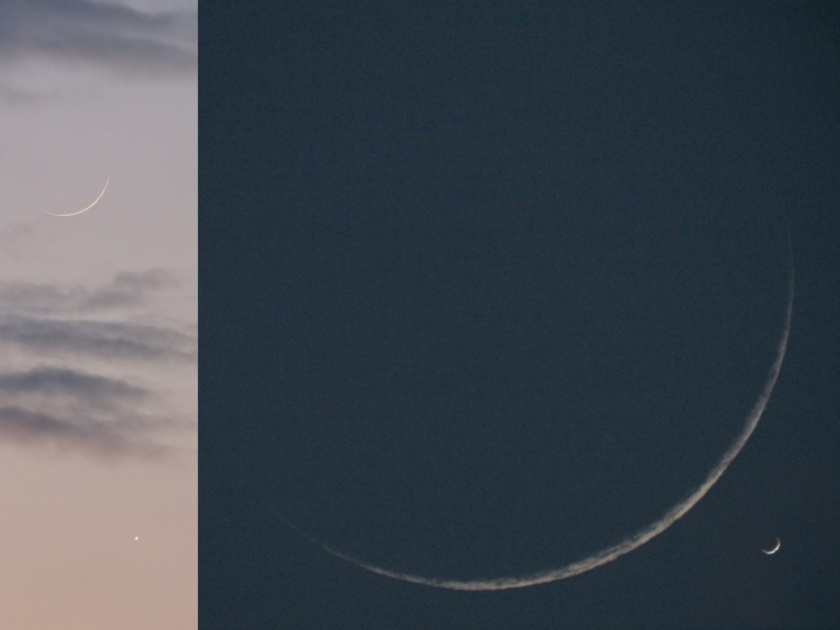
However, a couple of days ago the moon and Venus were quite close to each other in the evening sky, both showing a very thin crescent phase, as show in the accompanying image (which incidently I did not acquire myself!).  On the left hand side, the image shows the actual distance between the moon and Venus on the evening of 2 January, and the larger right hand image shows a composite revealing the correct relative sizes and phase of each object - I emphasise that they were not as close to each other as the right hand image suggests.

However it was a note-worthy occasion, the like of which will not happen again for a year and half or so.
Picture
The moon and Venus as they appeared on 2 January 2014
0 Comments

China's moon lander imaged from moon orbit

1/1/2014

0 Comments

 
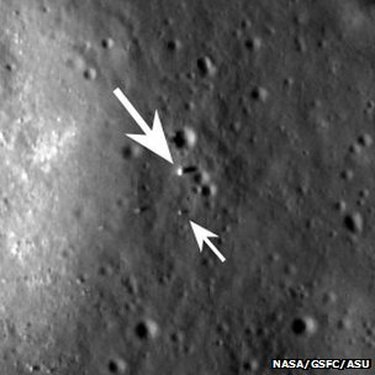
PictureChina's Chang'e-3 mission hardware imaged by NASA
China's Chang'e-3 lunar soft landing mission (see next blog entry) has recently been imaged from orbit by NASA's Lunar Reconnaissance Orbiter (LRO) spacecraft.  In the low sun angle, the 'mothership' (upper arrow) and the rover (lower arrow) show up brightly against the dark lunar surface.

0 Comments

China’s space programme shows clear intent.

12/30/2013

1 Comment

 
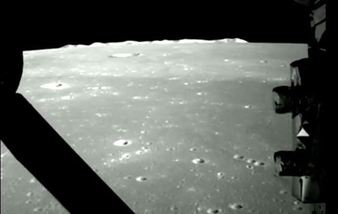
PictureImages of the lunar surface were returned during the descent
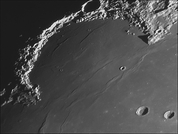
China’s Chang’e-3 mission to the moon before Christmas was the first robotic soft landing since 1976. Twelve days before the successful touchdown, the probe was launched on a Chinese Long March 3B launch vehicle.  The final descent manoeuvre was executed on Saturday 14 December, and 11 minutes later the vehicle soft-landed at 13.11 UT on a desolate volcanic plain in the Sinus Iridium (Bay of Rainbows) region of the lunar surface.  Some hours later at 20.35 UT the Yutu (Jade Rabbit) rover was deployed, beginning an intended exploratory mission of around 3 months.  Throughout the descent, and rover deployment images of each stage of the process were returned to Earth, giving confirmation of successful operation in addition to the usual means of relayed telemetry.

PictureLanding site in the Bay of Rainbows
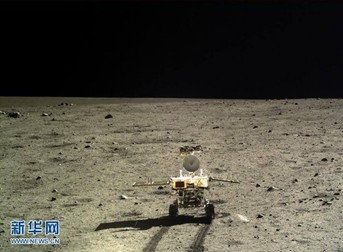
The rover has a very capable scientific payload, stands about 1.5 m in height with a mass of around 120 kg. In terms of ‘performance’it’s claimed its max speed is about 200 m/hour and can climb gradients up to 30 degrees.  Power is supplied by solar arrays, and it’s believed that it is also equipped with RHUs (radioisotope heater units) to keep it warm during the long lunar nights.

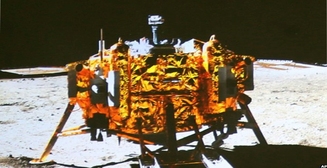
PictureThe Chang'e-3 'mother ship' on the lunar surface
So what does this very public display of space prowess on the part of the Chinese say about the Chinese space programme?  I think the main conclusion to be drawn is that the Chinese space exploration programme has something that the corresponding American programme
lacks – and that is a clear direction.  Don’t misunderstand me here –I’m not writing this to criticise the US activity.  The Americans have over decades ‘fought a hard-won battle’ to secure leadership in human space exploration, and it grieves many spectators (including myself) to see that role eroded.  America's space exploration programme is currently fraught with
confusion and a conspicuous lack of funding. Ever since Obama administration cancelled Bush's Constellation program that would have returned Americans to the moon, NASA’s near-term goal in human space exploration has been to visit an asteroid. However how Americans will get there is still an open question. On the other hand, it seems likely that the clear goal of the Chinese activity is to land people on the moon by the 2020s, and most likely there will not be US astronauts there to greet them.

PictureImage of the Jade Rabbit rover, taken by the 'mother ship'.
In the long run, this rivalry from Asia can only be a good thing in spurring competing nations (principally the USA) to action.  In the meanwhile, I would like to congratulate the People’s Republic of China on this impressive display of technology and operational expertise!


1 Comment

Have you seen the 'Gravity' movie yet?

11/18/2013

4 Comments

 
Picture
If the answer to this question is ‘no’, but you do intend to go and see it, then please do not read all of this post as I don’t wish to spoil your appreciation of the film.

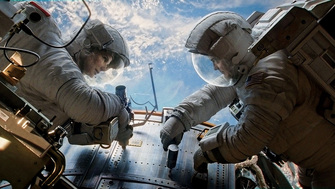
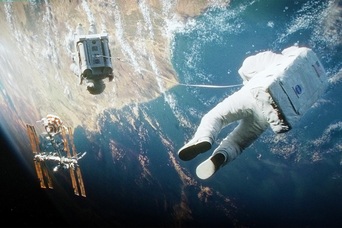
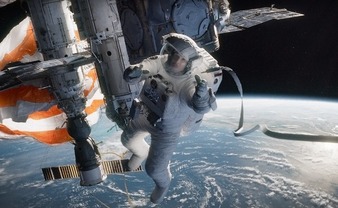
I went to see it last week and wow! – it’s a 5 star (out of five) for me.  And I don’t think that’s just because I’m a self-confessed space geek!  It stars George Clooney and Sandra Bullock as astronauts on a routine space
mission, during which things go dramatically wrong.  It is a bit of a thriller that will appeal to most people – a story of survival in the face of overwhelming odds. And it’s fair to say a masterpiece of cinematic technology, which captures the spectacle of being in orbit – particularly if you see it in 3D.  I’ve always been a fan of Sandra, and she plays a brilliant part in this. George is good as a worldly-wise, veteran astronaut, but I have to admit I kept thinking ‘Buzz Lightyear’ every time he was on screen. The depiction of local physics (weightlessness, conservation of momentum, etc) is really well done. It was one of those films when the word ‘wow’passes your lips unconsciously, due to the pure spectacle of some of the scenes! I will probably go to experience it again in IMAX 3D, but that’s just because I AM a space geek!

Picture
It’s interesting that I presented a paper to an international conference in Melbourne, Australia a long time ago in 1998, just a month or so before the
first components of the International Space Station (ISS) were launched (see reference at end).  The paper dealt with the short-term risk to the ISS arising from the breakup of a spacecraft – just the scenario depicted in ‘Gravity’.  It was amazing (and scary) to see the consequences of such an event played out so graphically in glorious 3D.

However, if you haven’t seen the movie yet, then you should stop reading here, and come back later (if you want to) after you’ve seen it.

The action starts when Matt Kowalsky (Clooney) and rookie astronaut Ryan Stone (Bullock) are performing a routine Space Shuttle maintenance mission on the Hubble Space Telescope, when a report of a spacecraft fragmentation comes over the comms. The first contact with the debris cloud destroys the Space Shuttle, and kills the other members of the crew, leaving Kowalsky and Stone stranded in orbit, with their oxygen supplies running out.  At this point, veteran astronaut Kowalsky takes command, and decides to take refuge on the ‘near-by’ ISS.  However, the only means of getting there is the back-pack propulsion unit he has been using during the
maintenance space walk.  Unfortunately, it is at this point that the logic of the storyline begins to break down – the orbital mechanics which hold it together are actually impossible – but then it IS only a story!  It wouldn’t be much of a story if the battle for survival, played out mainly by Ryan, ended abruptly at this point – which in fact would be the reality of the situation.

The problem is that the Hubble and the ISS are in very different orbits, and a delta-V of about 3 km/sec is required to go from one to the other – very much beyond the capability of Kowalsky’s back-up.  Delta-Vs are discussed in the book, but just to clarify, a delta-V is the amount of speed change needed to perform an orbital manoeuvre, usually supplied by the firing of a rocket engine.  OK – ignoring this detail – having got to the ISS, the space station is wiped out by a second pass of the debris cloud, but Ryan escapes the station in a Russian Soyuz spacecraft.  Since the ISS proves to be not much of a refuge, the next step is to attempt to reach the Chinese Shenzhou space station. However, she finds the Soyuz vehicle has been damaged and is out of fuel.  Not to be put off by such a minor problem, Ryan uses the spacecraft’s landing retro-rockets to make the transfer
between the two stations. Again, the issue of the delta-V to perform the manoeuvre causes a breakdown in the
story line.  Typically, the delta-V provided by the retros is around 3 or 4 m/sec, but a simple calc shows that a
manoeuvre of the order of 1 (and a bit) km/sec would be required to make the transfer.

Picture
Even if Ryan had enough propulsive capability, she would have been very disappointed in the outcome of the transfer, given the way it was executed.  She did the intuitive thing, which is to point the nose of her spacecraft at the target, and fire the engine.  However, if you do this you enter a higher orbit, and in higher orbits spacecraft travel more slowly.  So the outcome would be that Ryan’s Soyuz vehicle would drift further and further away relative to the Chinese station - orbital motion is often a very counter-intuitive thing!  Perhaps I should stop here …

I’m sure the film makers had lots of technical people advising them, so I’m certain all of the above issues were known at the outset – but then Hollywood is all about making a good story.  As a rocket scientist, I was still able to put all this aside and just enjoy the spectacle! And will Sandra get the Oscar?

Reference: Short-term debris risk to the International Space Station arising from a spacecraft fragmentation,
Swinerd, Barrows and Stokes, 49th International Astronautics Congress, Sept/Oct 1998, Melbourne, Australia, IAA-98-IAA.6.4.04


4 Comments

An Asian space race ...?

11/12/2013

0 Comments

 
Picture
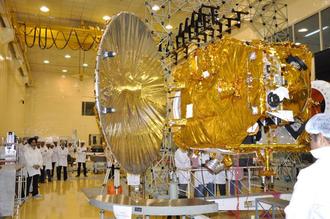
India has recently launched its first unmanned space mission to the Red Planet, and as a consequence, it has also received criticism in the media for spending money on ‘space’ when there are so many problems for the Indian people back here on Earth. This is a very easy charge to make, but is it valid?

On the other side of the coin, it should be pointed out that India has had a very active space programme for decades, mainly focusing on application satellites.  As a result, the quality of life of Indian citizens has been improved by the use of space-borne technology, in particular in the areas of communications, weather prediction and remote sensing applied to the search for natural resources.  However, the Mars mission is a new venture for the programme, since it is a purely scientific mission to investigate the atmosphere and surface of another planet. So why has the Indian space effort taken this direction?  
 
Again the media have come to the rescue with the suggestion that we now have an ‘Asian space race’, with India and China being the main contenders.  Unfortunately I don’t think this proposition holds water. I say ‘unfortunately’ because how great would it be if we had another full-blown international space race – last time this happened, between theSoviet Union and the USA, great things were achieved and much progress made in just a few short years during the 196os and 70s.  However the reality is that, although the Indian space programme is very impressive, its declared objectives are not in the least bit grandiose – continuing to focus mainly on space applications.  The Chinese on the other hand do have extravagant ambitions in the space arena, declaring an intention to take up the reigns of leadership in human space exploration within the next decade or so.  And with their drive, ambition and resource (both material and human), I have no doubt that they  will achieve this objective.

However, the USA, under the Obama administration, currently shows no appetite to regain its hard-won role of leadership in human spaceflight, so it appears that the next steps in the human exploration of space will most likely emerge from the Asian continent.


0 Comments

The black hole is about to feed!

7/18/2013

0 Comments

 
Picture
A few entries ago (see blog on April 11 2013) I focussed on the topic 0f the amazing black hole at the centre of our Milky Way galaxy, which is estimated to have a mass about 4 million times that of our Sun. 
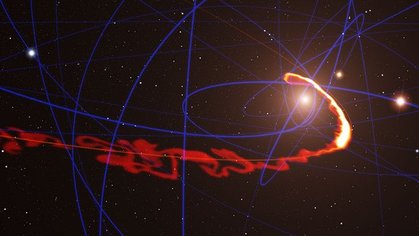
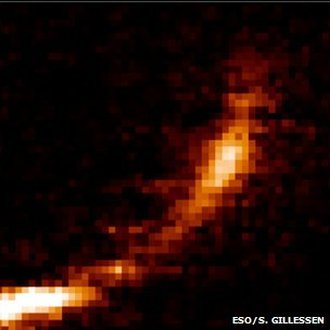
Recently astronomers have become aware of a gas cloud, called 'G2', close by the black hole being dragged towards it.   The cloud initially was about 3 times the size of Pluto's orbit, with a mass around 3 times that of the Earth.  But as it has accelerated towards the black hole, the tidal effects of the hole's gravity field is stretching the cloud out like spaghetti.  The observations tell us that the front of the cloud has already made its first pass of the black hole, and this part of the cloud is now speeding towards us at around 10 million km per hour (about 1% of the speed of light!).  The above picture shows a simulation of this 'spaghettification process', with the front of the cloud curling around the location of the blackhole.  Below shows an image as the astronomer's are currently seeing the event. 
During the time that the blackhole has been observed, it has been fairly quiescent since no significant material has fallen across the event horizon.  However, simulations suggest that some part of the cloud will fall into the hole, and astronomers are waiting to see how much it will 'light-up'.  However, whatever happens has already happened - about 26,000 years ago - since it takes this time for light from the central part of our galaxy to reach us.

Picture
Observed image of the G2 cloud.
Due to the tidal forces stretching
G2, the front of the cloud is now
moving around 500 km per second
faster than its tail

0 Comments

UK Government invests in the SABRE engine development

7/18/2013

0 Comments

 
Picture
UK Government is, at last, going to invest in Reaction Engines' SABRE engine technology and development (see also blog entries on December 4 2012 and May 3 2012 for more detail) to the tune of £ 60 million!
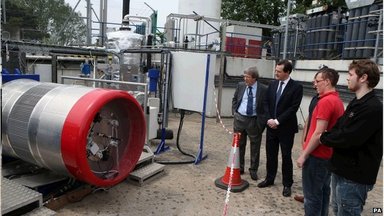
Reaction Engines was recently visited by George Osborne (Chancellor of the Exchequer) and David Willetts (UK Gov Science Minister) for discussions and to witness the ground testing of the new technology. £ 35 million will be released during 2014-15, and a further £ 25 million in 2015 - 16.  Although this interest and financial contribution is very welcome, about 4 times this amount will be required to complete the development phase.  Spin-off applications for the engine's heat exchanger technology will be also be sought.   Picture shows Alan Bond (CEO Reaction Engines) on the far left, with George Osborne.
This writer wishes Alan and his team every success in the coming years of hard work in getting this technology off the test stand and into the sky!

0 Comments
<<Previous
Forward>>

    Author

    Graham Swinerd - I hope to use this page to highlight current major events in space and spacececraft.

    Archives

    November 2024
    November 2022
    October 2016
    July 2016
    February 2016
    December 2015
    September 2015
    July 2015
    June 2015
    December 2014
    November 2014
    October 2014
    September 2014
    August 2014
    July 2014
    June 2014
    May 2014
    April 2014
    March 2014
    February 2014
    January 2014
    December 2013
    November 2013
    July 2013
    May 2013
    April 2013
    March 2013
    December 2012
    October 2012
    September 2012
    August 2012
    July 2012
    June 2012
    May 2012
    April 2012
    January 2012
    October 2011
    August 2011
    July 2011
    June 2011
    May 2011
    April 2011
    March 2011
    February 2011
    January 2011

    Categories

    All

    RSS Feed

Powered by Create your own unique website with customizable templates.