How Spacecraft Fly
  • Home
  • About the author
  • What's it all about?
  • Reviews
  • Picture gallery
  • External links
  • Contact me
  • Author's blog
  • Correction to text

Rosetta mission update 2

7/19/2014

5 Comments

 
Picture
Currently the Rosetta spacecraft is still on schedule to rendezvous with, and enter orbit around Comet 67P Churyumov-Gerasimenko (Comet C-G) on 6 August 2014.

The spacecraft successfully executed the 5th thruster burn, in a series of 10, on Wednesday 2 July.  The objective of this series of mid-course corrections is to bring the vehicle to a miss-distance of around 100 km with a relative speed of about 1.5 m/s ('walking pace') prior to orbit insertion.  On the day following the manoeuvre, 3 July, the spacecraft was approximately 43,000 km from its cometary target.

On Monday 14 July at a range of 12,000 km Rosetta's narrow angle camera captured a sequence of images of the comet's nucleus, which have been enhanced and smoothed into a movie showing its shape and rotation - see video below.  Using this data, the rotation period of Comet C-G has been estimated to be about 12.4 hours.  In terms of shape, the media have latched onto the idea that the nucleus bears a striking resemblancc to a rubber duck, so that it could be that it will acquire the unfortunate  tag of the 'rubber duck comet'.  The exotic shape, and relatively rapid rotation rate are, no doubt, the first of many interesting and surprising features of the mission.

The objective of the mission controllers is to bring the spacecraft to an orbit around the comet initially with a radius of around 70 km, and then to reduce this to about 30 km once the comet's gravity field has been quantified.  The current shape and rotation data will make the landing operation in November an interesting and challenging exercise.
5 Comments

Evidence for Cosmic Inflation - an update.

6/25/2014

0 Comments

 
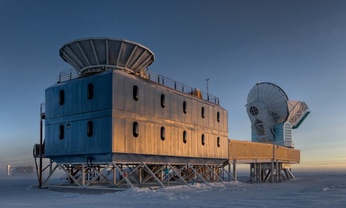
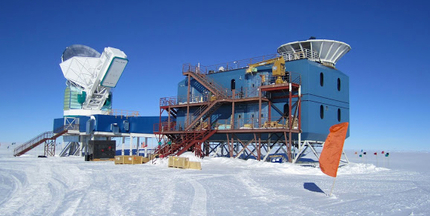
PictureThe BICEP2 observatory, located at the South Pole.
Recently the BICEP2 Research group announced far-reaching results which claimed to provide observational evidence for cosmic inflation in the split seconds after the Big Bang (see blog post April 15, 2014).  The work has now been formally published in Physical Review Letters  (see web reference below).  However competing research groups have now raised issued with the methods and analysis performed by the BICEP2 group, bringing their conclusions into question.  These criticisms are as a consequence of new information about polariation caused by galactic dust in the Milky Way from the European Space Agency's Plank observatory (see blog post April 4, 2013).  However the BICEP2 group stand by their results and conclusions, but accept that that big questions remain unanswered.  Clearly the conclusions about cosmic inflation need to be confirmed by other independent research groups - no big deal - just science in action!

http://journals.aps.org/prl/abstract/10.1103/PhysRevLett.112.241101

0 Comments

Rosetta mission update

6/22/2014

0 Comments

 
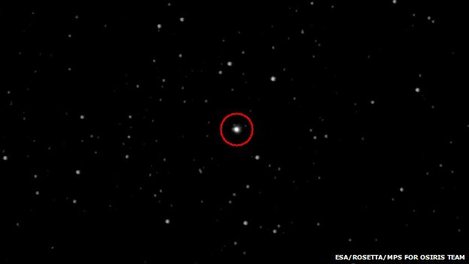
PictureComet 67P on 4 June, as viewed by Rosetta's narrow-angle camera.
Wednesday 18 June saw the successful 4th thruster burn, out of a planned series of ten.  This mid-course correction brought the spacecraft within 165,000 km of Comet 67P/Churnyumov Gerasimenko (on Thursday 19 June), which is around 43% of the Earth-moon distance.  Despite the fact that this is a very small distance on an astronomical scale, nevertheless the accompanying narrow-angle camera image shows the comet as a star-like object only 1 or 2 pixels across.  The camera used is primarily an important scientific payload, but during this phase of the approach to the comet it will be used extensively to aid the spacecraft's guidance and navigation.

Norminal arrival in orbit around the comet is planned for 6 August - the show is about to begin!

0 Comments

Rosetta mission preview – Part 4: rendezvous, orbit and landing phases

5/13/2014

0 Comments

 
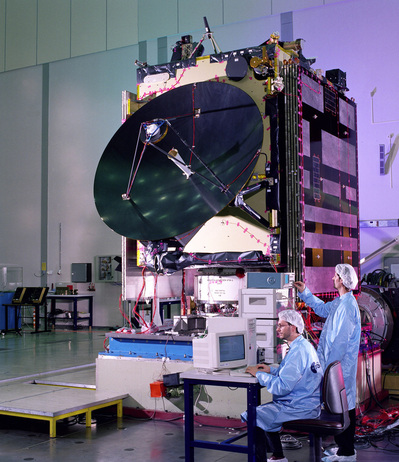
PictureESA's Rosetta spacecraft in the clean room prior to launch.
As I write, the first step in the process of rendezvousing with Comet 67P/Churnyumov-Gerasimenko (Comet C-G) was completed on Wednesday 7 May
2014.  Last Wednesday operators executed the first of 10 planned manoeuvres to accomplish orbit insertion about the comet nucleus on 6 August.  This comprised an engine firing of about 45 minutes duration to refine Rosetta’s trajectory to ultimately bring the spacecraft and comet together.  When I say ‘engine firing’, I am using the term loosely, as Rosetta doesn’t have a main rocket engine.  Instead it has a collection of 24 thrusters, each with a thrust of 10  Newtons (10 N). Of these, 16 are
dedicated to attitude control – in other words they produce torques to rotate the spacecraft. Only the remaining 8 thrusters are used for actually changing the speed of the vehicle, which in turn changes its trajectory.  A force of 10 N is about equivalent to the weight of a 1 kilogram bag of apples here on Earth, so the maximum level of thrust available for orbit manoeuvres is 80 N (or about 8 kg if you prefer).  The low thrust gives an idea why the first post-hibernation burn took so long.  The second planned burn will be larger, and take around 8 hours to complete.

So the next mission objective is to rendezvous with Comet C-G. The process of rendezvous requires not only that the spacecraft position and the comet’s position match, but also that their velocities are the same, therefore bringing them into a state of effectively zero relative velocity.  During earlier parts of the mission (see blog Rosetta mission preview Part 2, March 31, 2014) the spacecraft encountered various planets and asteroids, but these were fly-bys where position was approximately matched but relative speed was significant.  The process of
rendezvous is more complex, requires greater precision, and is also more expensive in terms of onboard resources (in particular propellant). This is why Rosetta has over a tonne and half of rocket propellant on board.

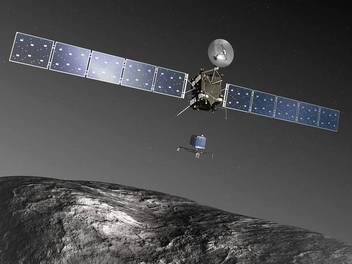
PictureArtist's impression of the deployment of the Philae lander.
In the coming weeks we can expect a number of mid-course corrections to be made, using the spacecraft’s propulsion system, so that the spacecraft will arrive at the comet in early August.  The process of approaching the comet, entering orbit and delivering a lander to its surface is discussed in some detail on pages 78 to 82 of the book How Spacecraft Fly, but I can give a brief outline here.  There are two aspects of particular importance in this process.  They are, firstly, that the orbital environment around the comet is a low-energy environment, and secondly that the comet will be irregularly-shaped (and probably rotating) so that its gravity field is very different from ‘normal’ celestial objects, which are usually spherical in shape.

So what do I mean by a low-energy environment?  Well the nucleus of Comet C-G is estimated (from remote observation) to be about 4 km in‘diameter’, so that its gravity field will be very weak.  Consequently, a spacecraft in orbit around it will move at a very low speed.  So for example, if Rosetta enters an initial orbit around Comet C-G with a radius of 100 km, then the circular orbit speed will be about 20 cm/sec (depending upon the density of the nucleus material). It’s likely that the initial orbit will be quite large, as the irregularities in the gravity
field get less the further away you are from the object.  So this does give an idea of how sensitively the Rosetta spacecraft’s speed needs to be matched to that of the comet to achieve orbit.  The escape velocity in this orbit will be around 30 cm/sec, so you can see that it would be easy for Rosetta to fail orbit insertion if there are even
small errors in speed.  This is why Rosetta’s propulsion system has been design around the use of small thrusters – so that the speed precision that can be achieved is of the order of 1 mm/sec.  The process of rendezvous
and orbit insertion is huge challenge for the spacecraft operators!

Having achieved such an orbit, the spacecraft would then be spend time observing the comet nucleus to quantify its irregular shape and to produce a ‘map’ of the gravity field.  Once this has been done to a specified accuracy, the orbit can be reduced in radius to, say, 10 km from which the lander can be deployed.  In this closer trajectory, the circular orbit speed increases to around 60 cm/sec, and the effects of the irregular gravity field become more pronounced.  Close orbits around irregularly-shaped, rotating objects will not be confined to a single plane (as is the case for a spherical object) and may result in an impact with the surface after a number of orbital revolutions.   This is why the period of observation and study in the higher initial orbit is required so that a lower orbit can be chosen that is stable. Once safely in the lower orbit, a further period of observation of the comet is required to refine knowledge of its gravity field, and to choose a scientifically promising site for Rosetta’s lander, which has been christened ‘Philae’.  Since Philae will fall under gravity to the surface, a good knowledge of the comet’s gravity field is required in order to hit the desire landing site within a specified error.

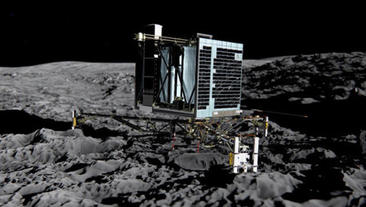
PictureArtist's rendering of the Philae lander on the comet's surface.
The altitude of the lower orbit also has to be chosen carefully. It needs to be sufficiently close to the nucleus so that Philae’s descent time is not too long. Since the gravity of the comet is so weak, it will take of the order of hours for the lander to fall a few kilometres to the surface. Also the
scientists will want to be ‘close to the action’ to maximise scientific return from Rosetta’s remote sensing instruments, particularly as the comet nears the Sun and plumes of gas and dust begin to erupt from the surface.  On the other hand, the engineers will want a higher orbit to keep the
spacecraft safe and uncontaminated.  Although I don’t know the precise mission plan, I would guess that a low
orbit radius of about 10 km (orbit altitude of about 5 km) would be likely. 

If all goes well, the deployment of the Philae lander is planned in November 2014.  If it freefalls from a height of, say, 5 km it will take about 2 to 3 hours to reach the surface, and will have an impact speed of around 1.5 m/sec at the surface (although details do depend upon the size and density of the nucleus – which are not known prior
to arrival).  Another detail which is unknown until the moment of contact is the nature of the surface – it may be
‘bouncy’ or ‘sticky’,or something in between.  The mass of the lander is about 100 kg, but in the low gravity at the surface of the comet it will weigh something like a 1/10th of a Newton, which is the weight of about 10 grams here on Earth.  Given that the lander may bounce off the surface upon impact, some way of securing the lander to the surface is required to achieve a stable landing.  The design includes the use of harpoons to secure the vehicle to the surface, and the legs are designed to dampen the initial impact. Communications with Earth to transmit science and image data will use the orbiting ‘mother spacecraft’ as a relay station to reduce the electrical power needed. The mission lifetime on the surface is planned to be at least one week, but an extended mission lasting months is may be possible.

Once all this is completed, the mission will continue through 13 August 2015 when the comet reaches perihelion (closest approach to the Sun) and will end nominally on 31 December 2015.  Once the lander has expired – through technical failure or as a result of damage caused by surface eruptions – the main orbiting Rosetta spacecraft will continue to observe at close quarters what happens to a comet as it warm up due to solar heating.  Obviously the effects of this has been seen remotely from Earth many times with the production of a comet’s dusty and gaseous tail, but this has never been observed in-situ before.  
 
The bottom line is that the Rosetta mission should give a huge return in our scientific understanding of comets and their role in the origin and history of the Solar System.   However, the technical challenges to orbit and land on comet C-G are very significant, and I wish ESA and the spacecraft operators every success in the coming months.  I hope this series of blogs previewing the Rosetta mission has been useful and has wetted your
appetite for what is to come.

0 Comments

Rosetta mission preview – Part 3: deep-space hibernation

4/28/2014

0 Comments

 
PictureRosetta - ESA's historic comet-chasing mission.
In the first two parts of this mission preview (see blog posts for March 18 and March 31, 2014), we looked briefly at the overall mission objectives of the Rosetta programme, some physical characteristics of the spacecraft, and the major events during its journey from launch in 2004 to its fly-by of asteroid Lutetia in July 2010.  
 
Beyond this encounter, Rosetta’s orbit took the spacecraft to a maximum distance from the Sun of about 800 million km (5.3 AU), beyond the orbit of Jupiter.  As mentioned in Part 1, the primary electrical power onboard is produced by solar arrays, which
convert solar energy into electricity. 
However, as Rosetta moved further away from the Sun, the amount of power the arrays produced dropped off. 
The rate at which this happens is driven by something called an ‘inverse square law’, but there is also a factor governed by temperature – the arrays’ efficiency increases as temperature decreases.  For an explanation of the factors which govern the conversion of solar energy into electrical power see pages 179-183 of the book How Spacecraft Fly.  Cutting a long story short, and doing a simple calculation (taking account of the inverse square law, but not of the temperature effects), shows that if the Rosetta arrays can produce 840 W of electrical power at a distance from the Sun of 3.2 AU (see Part 1), then at maximum distance the power level drops to about 300 W.  Given that the spacecraft needs at least a total of about 400 W to maintain full operation, there is a requirement to introduce a new operational mode (referred to as ‘hibernation’) in which power consumption is severely reduced.  Consequently, in June 2011 the mission operators began a process of putting Rosetta into a state of deep-space hibernation for 2 ½ years until 2014, when the spacecraft would again be close enough to the Sun to sustain full operation.

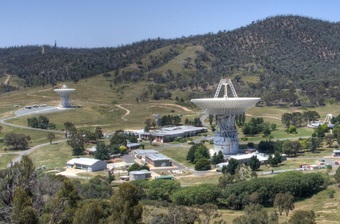
PictureNASA's Deep Space Antenna at Canberra, Australia.
One of the first requirements was to put the spacecraft (which is nominally 3-axis stabilised –see Chapter 8 of the book) into a gentle spin using the attitude control subsystem.  A spin rate of around 1 rpm was set up about an axis directed toward the inner Solar System, and the Sun in particular.  The axis about which the spacecraft spins becomes inherently stable in terms of pointing direction, so in this case the operators could be assured that the large solar arrays would remain
presented to the Sun during the period of hibernation.  Consequently, solar power, albeit at a reduced level, could be guaranteed during hibernation.  Following on from this, all electrical payloads and subsystems were progressively shut down, with the exception of the onboard computer (OBC) and the crucial heater components of the thermal control subsystem.  

The onboard computer’s operation was required so a wake-up alarm could be set, and so that the process of bringing the spacecraft back to normal operation could be achieved at the end of the hibernation period.  The heater systems were also controlled autonomously by the OBC to ensure critical spacecraft elements were maintained within acceptable temperature limits – for example, the OBC itself and the liquid propellant tanks and fuel lines (to prevent them from freezing).  During the 2 ½ years of hibernation, the power level steadily dropped as distance from the Sun increased.  Then after aphelion (maximum distance from the Sun), this power trend was reversed until Rosetta was about 670 million km from the Sun when there was once again enough solar energy to power the whole spacecraft.

PictureNews of Rosetta's survival was greeted with some relief at ESOC.
After the OBC delivered the wake-up call at 10.00 UT on 20 January, the attitude control subsystem was brought online to execute a despin manoeuvre and to point the spacecraft’s high gain antenna to Earth to let the mission operators know that the spacecraft had survived hibernation.  The signal was received by NASA’s Deep Space Network antennas at Goldstone California and Canberra Australia at 18.18 UT on the same day, and this was relayed over-ground to Rosetta’s operations team at the European Space Operations Centre (ESOC) in Darmstadt Germany, where news of Rosetta’s survival was received with great relief and celebration.

At wake up, Rosetta still had 9 million km to go to reach Comet 67P/Churnyumov-Gerasimenko, giving operators a few months to check out the spacecraft and its payload instruments.  Rosetta’s first images of the comet are expected in May 2014 from a distance of about 2 million km.  At the end of May, a major course correction manoeuvre will be executed to initiate rendezvous with the target in August.  Release of the lander is scheduled for November 2014.  Watch this space, for Part 4 of this mission review in which we’ll be looking ahead at the rendezvous, orbit and landing phases of the mission.


0 Comments

Do we have experimental proof of cosmic inflation?

4/15/2014

2 Comments

 
PictureThe BICEP2 observatory is located at the South Pole
Just recently the scientific press has ‘gone bananas’ over recent observational results acquired by a ground-based observatory located in Antarctica.  So what’s all the fuss about?

The observatory, called BICEP2 (after ‘Background Imaging of Cosmic Extragalactic Polarization’), is located at the Amundsen-Scott Station very close to the geographic South Pole.  Recent observational data has revealed a particular kind of polarization
of the Cosmic Background Radiation (CBR) which is seen as evidence of gravitational radiation in the very early universe.  In particular, theories of cosmic inflation predict the existence of such gravitational radiation, so these results can be assumed to be the first experimental evidence that cosmic inflation actually occurred in the split second after the Big Bang.  For observational cosmology, this is a very big deal – and rumours of Nobel Prizes hang in the air for theorists and experimentalists who have championed the idea of cosmic inflation since the early 1980s.

Looking at that last paragraph, there is an awful lot of terminology there to unpack to make any sense of why scientists are getting so excited.  So let’s take a step or two backwards to try to clarify why this is (potentially) so
important.

First off then, the current scientific view of the beginning of the Universe is the ‘Big Bang’ (BB).  In this event, which is estimated to have occurred about 13.8 billion years ago, all the energy and matter contained in the Universe was created – but more importantly space and time also came into existence.  This is an important point, as there seems to be a commonly-held misconception that space and time existed prior to the Big Bang, and that the BB was simply an explosion of matter and energy taking place in this pre-existing space.  However, it’s important to understand that the 4-dimensional world which comprises our Universe, which scientists call ‘space-time’, actually came into existence at time zero in the BB, and that the fabric  of space-time itself has been expanding ever since, as discovered by Edwin Hubble in the 1920s.  This subtle point is discussed briefly in the book How Spacecraft Fly on page 256.  So, for example, asking questions about what happened before the BB is
regarded as meaningless as time itself did not exist prior to this event.

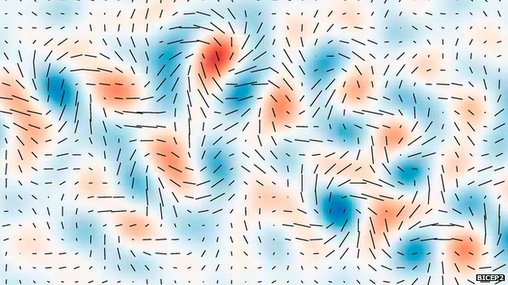
PictureGravitational waves from inflation put a characteristic 'twist' in the polarization of the CRB.
The BB and universal expansion are predicted by Einstein’s theory of gravitation – general relativity – which he published i1916. However, as these solutions to
Einstein’s equations were examined, it was realised that this ‘standard model’
had significant problems. 
Principally, in order to get the universe we observe now, the initial conditions at ‘time zero’ has to be precisely specified to about 1 part in 10 to the power of 60 (that’s a big number – 1 with 60 zeros after it).  There are essentially two puzzles about how the Universe looks now.  The first of these is the puzzle that the Universe looks the same on opposite sides of the sky (isotropy) even though there has not been time since the Big Bang for light (or anything else) to
travel across the Universe and back. So how are physical conditions on opposite horizons "synchronised"?  The
second is called the flatness problem.  This is the puzzle that the space-time of the Universe is very nearly flat, which means that the Universe sits just on the dividing line between eternal expansion and eventual recollapse.  Without getting into the discussion about ‘curved’or ‘warped’ space-time, our Universe appears to be flat – which just means that the Universe obeys the classical rules of geometry set down centuries ago by Euclid (e.g. the internal angles of a triangle add up to 180 degrees etc.).

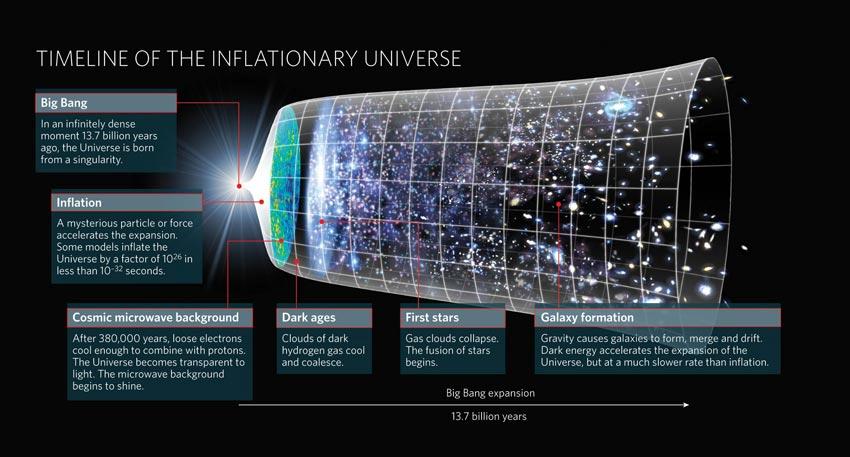
In the late 1970s / early 1980s a number of cosmologists independently came up with the idea of ‘cosmic inflation’ to attempt to resolve these issues with the ‘standard model’, the principal player being Alan Guth.  This refinement to the standard model involves an extremely rapid expansion – an inflation– of the fabric of space-time in the seconds and minutes after the BB.  Technically, this is referred to as an exponential expansion - which means that the universe doubles in size at each tick of the clock.  From something much smaller than the size of a proton at time zero, it is estimated that space-time grew to about a million billion kilometres across in
less than a minute, and continued growing fast.  This rate of growth is actually in excess of the speed of light. 
However, Einstein’s speed limit was not violated in this process, as this is the rate of expansion of the fabric of space-time, and not the speed of matter relative to space-time.

Picture
Schematic of the Big Bang model of the creation of the Universe, including the inflationary period.
So how does this addition to the model resolve the issues discussed above?  This inflationary process would resolve the isotropy problem by taking regions of space that were once close enough to have got to know each other well and spreading them far apart, on opposite sides of the visible Universe today.  Also the huge inflation of the size of the Universe would tend to smooth-out space-time to make the Universe flat.  For example, if you think about something the size of a soccer ball, then the surface is clearly curved.  However if you inflate the ball up to, say, the size of the Earth then the surface appears flat.

Having said all this I am not sure whether we understand the mechanism that drives cosmic inflation – if there is anyone out there who can throw some light on this, that would be helpful.  I seem to recall that some of the early vacuum solutions of Einstein’s equations of general relativity, attributed to Willem de Sitter, described models of the Universe with exponential rates of expansion.  Clearly the real Universe contains matter, so I don’t know how relevant these de Sitter solutions are.   Another possibility is that a different agency, such as dark energy, may have been responsible for cosmic inflation – see for example the discussion of dark energy in the June 21, 2012 blog entry on this website.  We suspect that dark energy may be driving the gentle acceleration of the expansion rate that we observe today, and maybe in the early Universe it may have been the mechanism for the much more vigorous inflationary expansion.

If you accept that cosmic inflation occurred in the early Universe, then a consequence of this is the theoretical prediction that gravitational radiation was produced in the process, and this cosmological gravitational radiation
continues to exist in the current era.  Gravitational radiation is another consequence of Einstein’s general
relativity. The theory says that this is produced when massive objects, such as stars, move rapidly relative to each other. But what is it? It is worth noting that it is unlike any other radiation with which we are familiar (such as light, or radio waves). The theory predicts that massive objects warp, or distort, the very fabric of space and time, and in certain circumstances the distortion can propagate as a wave, producing gravitational radiation. This is something that we have yet to observe directly, as the technology required to do this is extremely challenging. However, its existence has been confirmed indirectly by observing unusual distant objects, such as the binary system described in the September 1, 2012 blog entry on this website.

The recent observations made by the BICEP2 observatory were directed at measuring a physical characteristic (i.e. a particular kind of polarization caused by the gravitational radiation) of the Cosmic Background Radiation (CBR).  The CBR itself has been examined in great detail by a number of ground-based and space-borne observatories – see for example the April 4, 2013 blog entry on this website, which describes the Plank Space Telescope’s observations of the CBR.  For thousands of years after the Big Bang the Universe comprised a very hot and dense ‘fireball’, which was opaque to the transmission of light. However, about 380,000 years after the initial event, matter and radiation ‘decoupled’ and the light we now see as the CBR was free to propagate throughout the Universe. Because of the huge degree of expansion of the Universe since, the wavelength of this 'first light' has been stretched so that we now see it as long wavelength microwave radiation with a very low temperature – about 2.7 degrees above absolute zero (absolute zero on the Celsius scale is around -273 degrees). 

So finally (and I apologise for the interminable length of this blog post!) I think we have all the bits of the puzzle which I described in the second paragraph above.  However, I think it was worth having a go at trying to explain what this is all about as, if the result is confirmed by other observatories, it will be a huge step in the validation of our current understanding of the creation of our Universe. I think what I find extraordinary about all this is that we can make observations in the current era which informs us of the behaviour of the Universe in the split second after time zero when it was a ‘quantum object’ smaller than a proton!

2 Comments

Rosetta mission preview – Part 2

3/31/2014

2 Comments

 
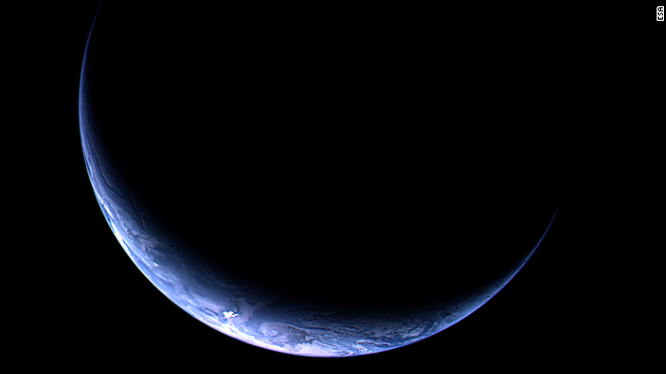
PictureImage taken of Earth during Rosetta's third Earth gravity-assist manoeuvre.
So why is the spacecraft called ‘Rosetta’?  Just as the Rosetta Stone enabled Champollion to decipher the language of ancient Egypt (see for example
https://www.britishmuseum.org/explore/highlights/highlight_objects/aes/t/the_rosetta_stone.aspx), so the Rosetta space mission aims to probe the history of the Solar System by analysing one of its oldest remnants – a
comet.

As we said in Part 1 of this preview, the Rosetta spacecraft was launched on 2 March 2004 atop a European Ariane 5 launch vehicle. This was the first step in Rosetta’s epic odyssey to rendezvous with Comet 67P/Churnyumov-Gerasimenko in August 2014.  At the time I remember thinking, impatiently,“that’s 10 years in interplanetary space”, and that many of the people that work on the programme (and me) will be retired by the time we get to the pay-off!  However, despite this there was a lot of excitement about what Rosetta would discover once up close and personal with the comet.  But there was also an air of concern that some technical issue may occur onboard the spacecraft in the intervening 10 years that would deprive us all of the scientific revelation that would result from a successful mission.

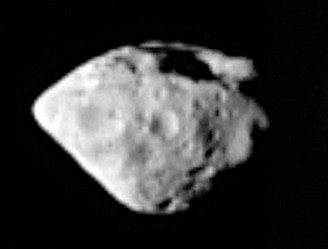
PictureRosetta image of Steins taken September 2008
Anyway, we are now at the other end of this long wait, and on the threshold of this revelation.  It has been a long, but eventful interplanetary journey, and the
spacecraft appears to be in good health – at least there is no indication from ESA that there is anything amiss technically with the spacecraft.  I guess that if there are technical issues which the operators believe they can work around, then it’s unlikely that the Agency or the spacecraft manufacturer (EADS Astrium) are going to be telling us about them at this stage.  So we can only assume that all is well with the mission, and we can look forward to a feast of astronautical history-making over the next few months.

After launch in 2004, the interplanetary trajectory was a complex series of gravity assist swing-by manoeuvres, three of Earth (March 2005, Nov 2007 and Nov 2009) and one of Mars (Feb 2007).  Using this technique, the spacecraft was able to acquire sufficient energy to reach the comet without having to expend excess onboard
propellant.  How this works is explained in some detail on pages 71 to 78 of the book How Spacecraft Fly, but very briefly the spacecraft executes a fly-by of the target planet.  This must be performed by flying‘behind’ the planet, with respect to the planet’s forward motion, and the direction of the outgoing trajectory of the spacecraft must be roughly aligned with the planet’s path along its orbit around the Sun.  Done in this way, the fly-by allows the spacecraft to steal a little of the planet’s momentum, which boosts the spacecraft's speed relative to the Sun. See the accompanying beautiful image of the Earth, taken by Rosetta during its third Earth gravity assist manoeuvres in November 2009.

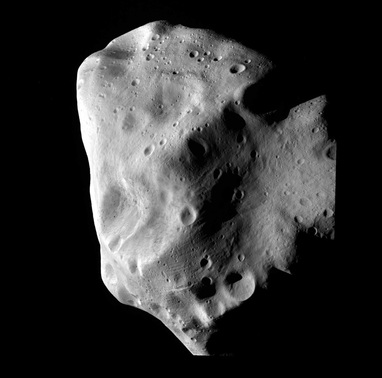
PictureRosetta image taken during the Lutetia encounter in July 2010
During this phase of the mission, Rosetta also imaged 2 asteroids at close quarters –first asteroid 2867 Steins, followed by asteroid 21
Lutetia – see accompanying pictures.  The Steins encounter occurred on 5 Sept 2008, with Rosetta approaching within 800 km range at a fairly low relative speed of 8.6 km/sec.  As can be seen, Steins is an irregularly shaped object. 
It is also quite a small object with a maximum dimension of around 5 km.  The second asteroid encounter (Lutetia) occurred on 10 July 2010.  Lutetia is a significantly larger object, compared to Steins, being about 100 km across.  This time Rosetta passed by at a minimum range of about 3,170 km with a relative speed of 15 km/sec, resulting in images of this irregularly-shaped asteroid with a maximum resolution of approximately 60 m/pixel.

Watch out for the next episode of this Rosetta mission preview when we’ll take a look at the ‘deep-space hibernation’ phase of the mission – a bold and risky operation, and another ‘first’ for the Rosetta programme and the European Space Agency.

2 Comments

Rosetta mission preview – Part 1

3/18/2014

1 Comment

 
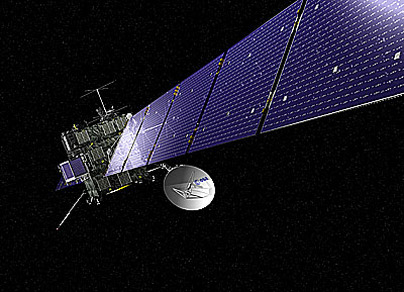
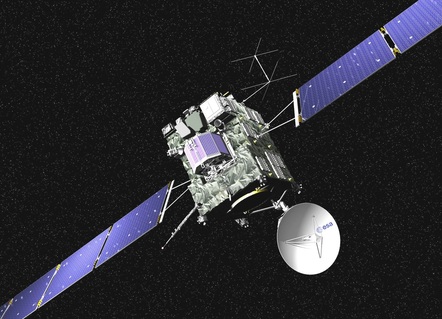
PictureRosetta spacecraft configuration
If all goes well with the European Space Agency (ESA) Rosetta mission, 2014 will be an historic year for the Agency and for astronautics in general.

The objectives of the mission are extremely ambitious, and it’s all about to happen this year and next. 
So I thought it a good idea to prime everyone with a timely preview of
what’s on the ‘menu’ of events for 2014/15.

The mission objectives of the Rosetta spacecraft are to chase a comet, rendezvous with it, orbit it and deploy an instrument package to land on its surface.  The comet orbiting and landing phases have never been attempted before, and if ESA can pull this off it will be a truly historic and remarkable achievement. 

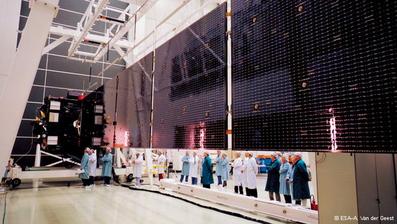
PictureRosetta solar array deployment test prior to launch.
You may ask the obvious question ‘Why go to a comet anyway?’.  Effectively comets are
giant dirty snowballs (typically 1 to 10 km in diameter), usually in highly eccentric closed orbits or open near-parabolic trajectories around the Sun.   So why is a load of dusty
iceballs so interesting? This is because they are generally believed to be the remnants of material left over from the formation of the Sun and planets – and as such are samples of very old (and generally uncontaminated) material left over from the original solar nebula dating from about 5 billion years ago. Consequently, analysis of the comet’s composition will hopefully tell us a good deal about the beginning of the Solar System.  Also it is generally assumed that comets were the original source of the abundance of water found on planet Earth.  During the formative years of the Earth, the Solar System was full of debris (including comets), and all of the larger bodies in the Solar System were subjected to violent bombardment.  Obvious evidence of
this period can be seen on the cratered surfaces of many planets and moons throughout the Solar System.  The
majority of the craters formed on the Earth during this period have not survived the extensive processes of erosion that occur on Earth, but the ocean’s of water are believed to be evidence of cometary impacts over time. 
Also long-range analysis of comets shows evidence of organic molecules, which raises the question about whether comets had anything to do with the rise of life on planet Earth.  All of these issues, and many others, will be addressed by the instrument package to be deployed on the comet’s surface.

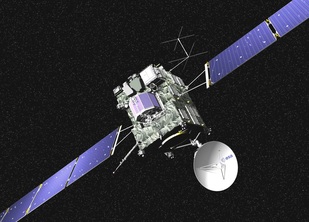
Rosetta (see picture, and image heading up the ‘External links’ page of this website) is a large spacecraft, with a box-like central structure of approximate dimensions 2.8 m x 2.1 m x 2.0 m. Stretching either side of this structure are two large solar array panels with an area of 64 square meters presented to the Sun to raise power (840 Watts at a distance from the Sun of 3.4 AU – you may recall from the book How Spacecraft Fly that an Astronomical Unit (AU) is the average Earth-Sun distance of around 150 million km).  This gives a 32 meter total span across the spacecraft.  Communications with Earth are facilitated by a 2.2 m high-gain antenna.  The
total launch mass of Rosetta is about 3,000 kg, of which 2,900 kg comprises the comet orbiter and 100 kg the comet lander.  To undertake the various manoeuvres required during the mission, this mass budget includes 1,670 kg of rocket propellant.
 
The Rosetta was to be lofted by the European Ariane 5 launch vehicle, with the launch scheduled for January 2003.  At that time the target comet was identified as 46P/Wirtanen.  However, due to an Ariane 5 launch failure during 2002, the Rosetta launch was delayed to March 2004, and a new target comet had to be selected.  Consequently, the comet now subject to Rosetta’s scrutiny is 67P/Churnyumov-Gerasimenko.

The table below gives a concise summary of the main Rosetta mission events.  Watch this space for Part 2 of the Rosetta mission preview.

Nominal date

2 March 2004

4 March 2005

25 February 2007

13 November 2007

5 September 2008

13 November 2009

10 July 2010

8 June 2011

20 January 2014

May 2014

August 2014

August 2014

November 2014

13 August 2015

31 December 2015
Event

Launch

First Earth gravity  assist

Mars gravity assist

Second Earth gravity assist

Asteroid Steins flyby

Third Earth gravity  assist

Asteroid Lutetia flyby

Enter deep space hibernation

Exit deep space  hibernation

Comet rendezvous  manoeuvre

Arrive at comet

Start global mapping of comet

Lander delivery

Perihelion passage

Mission End
1 Comment

Water spouts from the surface of Europa?

3/3/2014

0 Comments

 
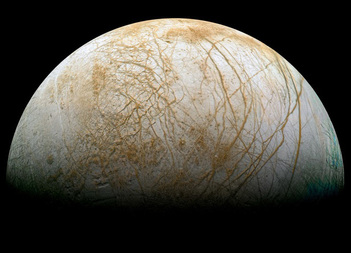
PictureThe crazed icy surface of Jupiter's moon Europa.
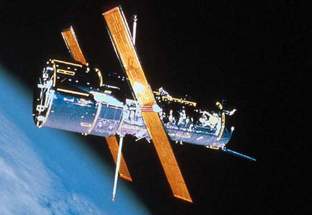
Recent images, from the Hubble Space Telescope, show evidence that water is erupting from the surface of Jupiter’s frozen moon Europa.  
 
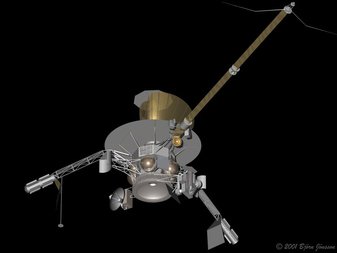
Europa is one of the four largest moons of Jupiter, called the ‘Galilean moons’ as they were discovered by Galileo when he turned the first telescope on to the giant planet in 1610. Observations by various telescopes and passing spacecraft show Europa as an ‘ice planet’, having the appearance of a white snooker cue ball.  However closer examination principally by the spacecraft Galileo, which orbited the planet from 1995 until its suicidal dive into the planets atmosphere in 2003, shows the surface to be crazed with cracks and streaks.  It also apparent that surface craters are rare, suggesting a geologically young
surface.

PictureThe Hubble Space Telescope.
Galileo’s (the spacecraft) observations of Europa raised huge interest in the late 1990s as they suggested that the moon may have an ocean of liquid water beneath the
outer ice crust.  Some background to this discovery is discussed briefly on pages 231-232 of the book How Spacecraft Fly.   The reason why scientists got so excited about this was the unlikely prospect that Europa may be the only place in the Solar System (other than the Earth) to host life.  The logic of the argument is something along the lines of the following.   Firstly, the existence of a sub-ice ocean suggests there must be some source of heat energy coming from below the surface to produce and maintain water in a liquid state.  The mechanism for this, it was realised, comes from consideration of Europa’s orbit around Jupiter which is elliptical.  Consequently, the distance varies by about 13,500 km every orbit period
of 3.55 days.  Because Jupiter is so massive, it causes significant tides in the solid structure of the moon.  So as Europa orbits, and its distance from Jupiter varies, it is squashed and stretched by Jupiter’s tidal forces.  This in turn produces an internal heat source capable of causing volcanic activity in the moon’s core.

PictureThe Galileo spacecraft orbited Jupiter 1995-2003.
So the current view is that beneath Europa’s icy surface there is a liquid water ocean maintained by tidal heating, with thermal vents in the ocean floor. 
These vents are likely to be similar to the thermal vents found in the deep ocean trenches here on Earth, where scientists have found unique forms of life energised not by the Sun but by geothermal energy (or volcanism).  So all this adds up to the idea that a
similar thing may be happening on Jupiter’s frozen moon.

The water spouts recently observed by Hubble gives further evidence to the notion of a sub-ice liquid ocean on Europa.  The water vapour plumes have been seen to rise to a height of 200 km above the surface, and it is estimated that about 7 tonnes of water per second is being ejected from the surface at about 700 metres per second.  Despite the vigour of these emissions, the water has insufficient energy to escape Europa’s gravity field, and the water falls back onto the moon’s surface.  Another characteristic is that the water erupts for around 7 hours at a time, and peaks when the moon is furthest from Jupiter, reinforcing the theory that the source of energy is derived from tidal effects in the moon.

This recent evidence is significant for three main reasons:
-        it reinforces the theory that a subsurface ocean exists,
-        it shows that the sub-ice ocean may be easily accessible from the surface,
-        and thirdly, there may be organic molecules on Europa’s surface.

Clearly, since the findings of the Galileo spacecraft, there has been a lot of interest in sending robotic spacecraft to the surface of Europa to investigate the intriguing idea of life on Europa.  It was believed that the ice crust may be kilometres thick, so that landing a sufficient source of energy to melt an access tunnel would be required to investigate the sub-ice ocean. Also, due to the moon’s relatively close proximity to Jupiter, it is very difficult to land a large payload mass on the surface of the moon, compounding this problem. However, the recent discovery of water vents suggests that the ocean may be more accessible than previously thought.

0 Comments

Titan's huge gas reserves!

2/19/2014

0 Comments

 
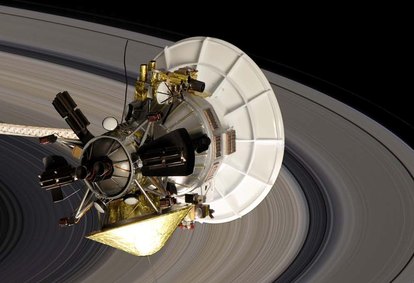
PictureThe NASA/ESA spacecraft Cassini against the backdrop of Saturn's rings
In 2004 a NASA/ESA spacecraft called Cassini entered orbit around Saturn, and in the subsequent 9 years it has revolutionised our knowledge of this ringed giant and its accompanying moons.  Saturn is impressive – the true ‘lord of the rings’ – and the many images produced by this 2.5 tonne spacecraft have been stunning.   It is anticipated that the Cassini mission will end in 2017, with a planned suicidal dive into Saturn’s atmosphere.

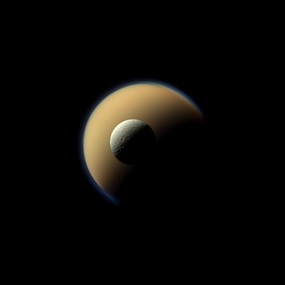
One of its principal scientific targets of interest has been Saturn’s largest moon Titan, measuring about 5,150 km (3,200 mile) in diameter.  Unlike the other Saturnian moons, Titan is veiled in a thick atmosphere as can be seen in the accompanying image.  As a consequence, the surface cannot be seen by visible band cameras, so a long-term project for the Cassini operators has been to use the spacecraft’s main antenna as an imaging radar to penetrate the clouds to reveal the landscape beneath.  This has shown a terrain remarkably Earth-like in appearance, with mountains, valleys, rivers and lakes.  Clearly erosive processes very similar to those on Earth are occurring on Titan, but with a surface temperature around-200 degrees Celsius, erosive processes driven by liquid water
cannot be responsible for shaping the landscape.  Remarkably, it was soon realised that, at these cryogenic temperatures, liquefied gas must be the driving force.   In particular it is predominantly liquid methane (in combination with a chemical cocktail of other elements such as ethane, propane, etc) that is responsible –
which is essentially liquefied natural gas (LNG).

PictureSaturn's moons Rhea (foreground) and Titan.
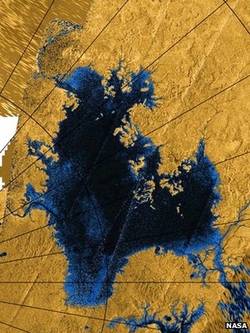
In the Northern hemisphere of the moon, Cassini has discovered two large lakes of LNG.  A detailed survey of the
smaller the two – called Ligeia Mare – has recently been completed showing an average lake depth of around 170 m (560 feet).  Overall it is estimated that Ligeia contains about 9,000 cubic kilometres of LNG, which is about 40 times the proven reserves of oil and gas here on Earth! In the unlikely event that you could transport all this to Earth, there would not be enough oxygen in the Earth’s atmosphere to burn it all. 

The second lake – called Kraken Mare – has not yet been fully surveyed by Cassini.  However, Kraken appears to be about 4 or 5 times larger in volume than Ligeia with therefore perhaps 200 times Earth’s proven reserves of oils and gas.

PictureThe Ligeia Mare as revealed by Cassini.
More info on the remarkable Cassini mission to Saturn can be found at  http://www.nasa.gov/mission_pages/cassini/main/, and the characteristics of the spacecraft are reviewed in Chapter 7 of the book ‘How Spacecraft Fly’.


0 Comments
<<Previous
Forward>>

    Author

    Graham Swinerd - I hope to use this page to highlight current major events in space and spacececraft.

    Archives

    November 2024
    November 2022
    October 2016
    July 2016
    February 2016
    December 2015
    September 2015
    July 2015
    June 2015
    December 2014
    November 2014
    October 2014
    September 2014
    August 2014
    July 2014
    June 2014
    May 2014
    April 2014
    March 2014
    February 2014
    January 2014
    December 2013
    November 2013
    July 2013
    May 2013
    April 2013
    March 2013
    December 2012
    October 2012
    September 2012
    August 2012
    July 2012
    June 2012
    May 2012
    April 2012
    January 2012
    October 2011
    August 2011
    July 2011
    June 2011
    May 2011
    April 2011
    March 2011
    February 2011
    January 2011

    Categories

    All

    RSS Feed

Powered by Create your own unique website with customizable templates.