How Spacecraft Fly
  • Home
  • About the author
  • What's it all about?
  • Reviews
  • Picture gallery
  • External links
  • Contact me
  • Author's blog
  • Correction to text

Philae makes it down to the surface alive!

11/13/2014

0 Comments

 
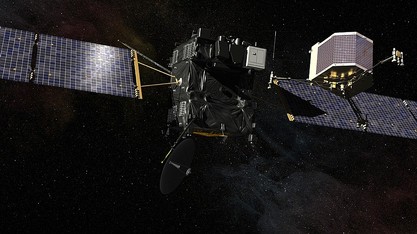
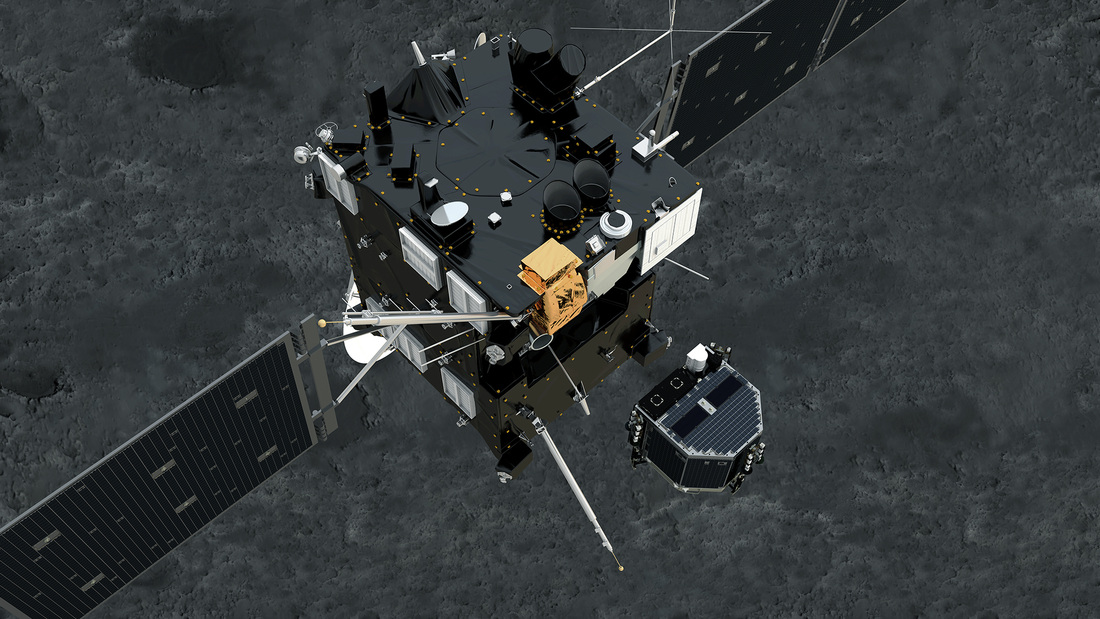
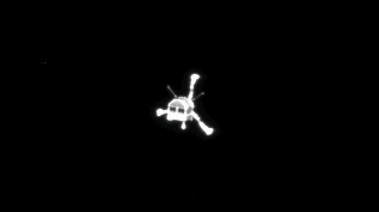
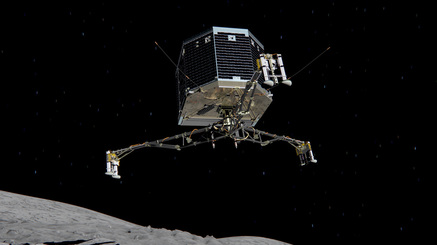
PicturePhilae lander, taken from Rosetta after separation
Facebook post 10.00 UT Wednesday 12 November:   Image of the Philae lander taken from the Rosetta spacecraft, as the lander began its descent at 08.35 UT this morning. All antennae and landing gear in place

Facebook post 14.40 UT Wednesday 12 November: 
Rosetta lander mission update 14.40 UT: ESA confirms that the link with the Philae lander has been established successfully - comms with Earth has to be via the Rosetta spacecraft in orbit. The dynamics team have just confirmed that the lander is on the correct trajectory. Finally landing is expected at 15.34 UT, so confirmation signal should be received at about 16.02 UT. Everything is going really well - although of course noone has control over what the lander may encounter on touchdown.
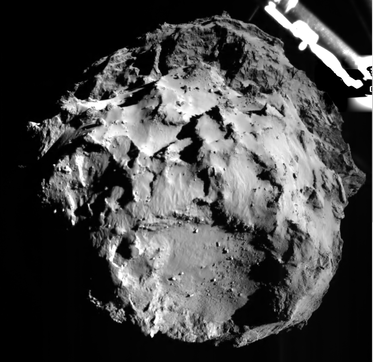

PictureImage of landing site 3 km range taken by Philae on descent
Facebook post 16.15 UT Wednesday 12 November:  Rosetta lander mission update 16.15 UT: we have confirmation that the lander is on the surface of the comet and providing telemetry. So looks like we're down and alive - absolutely amazing!

Facebook post 16.45 UT Wednesday 12 November:  Rosetta lander mission update 16.45 UT: a more detailed (but still early) look at the state of the Philae lander indicates that it may not be securely attached to the surface - no indication that the harpoon anchors have fired. This is causing some concern, and the lander controllers have a difficult decision as to whether to attempt to fire the anchors again. The lack of security is an issue as, due to the very low surface gravity, the weight of the lander is tiny despite the fact that its mass is around 100 kg. So firing the harpoon anchors now may make the situation worse. They are still expecting to receive imagery from the surface this evening.
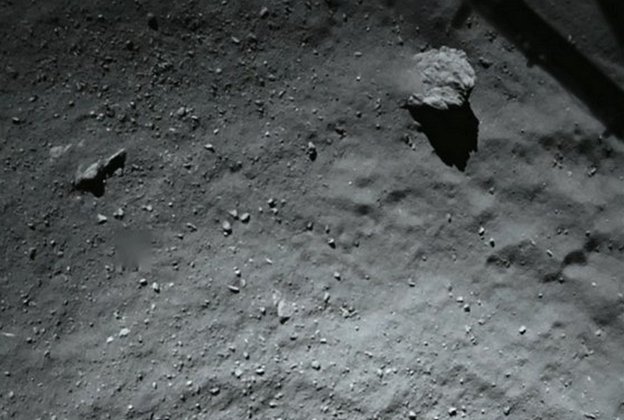
Picture
Landing site image taken by Philae just prior to touchdown (range unknown).
0 Comments

More recent Facebook updates ...

11/12/2014

0 Comments

 
Picture
More recent Facebook posts today Wednesday 12 November 2104:

Posted at 08.25 UT:Rosetta mission update 08.25 UT Wed 12 Nov: separation of the lander Philae is due in 10 mins. Because of the distance of Rosetta from Earth, confirmation signal will be take 28 mins to get to Earth, so earliest we'll know about the separation is 09.03 UT. It is planned for Philae to take a farewell picture of Rosetta, so hopefully I can post that sometime today. Decision to go for landing was taken despite a problem on the lander. There is an upward facing cold gas thruster (i.e. small rocket engine) designed to fire on contact with the surface to stop the lander bouncing in the very low gravity. This could not be activated. However there are backup systems - ice screws and harpoons - so fingers crossed - it's going to be a long day.

Posted at 09.05 UT:

Rosetta mission update 09.05 UT: telemetry has confirmed that the Philae lander has separated from the Rosetta spacecraft, and is on its way down to a landing on the icy surface of Comet 67P in about 7 hours time. From here on everything is automated, and governed by Isaac Newton (i.e gravity).

0 Comments

Rosetta orbital strategy surrounding the landing event.

11/12/2014

0 Comments

 
A busy time for the operations team at the European Space Operations Centre (ESOC) in Darmstadt, Germany.
The above video may help in understanding what's going on today - 12 November 2014 (landing day hopefully).  An element of marking time is provided by the comet nucleus, which rotates about every 12 hours.
0 Comments

Rosetta mission comet landing updates.

11/11/2014

0 Comments

 
Picture
Recent updates that I've posted on Facebook - today 12 November 2014 is hopefully the day when the robotic lander Philae will land on a comet nucleus.

Posted 22.45 UT, Tuesday 11 November:  Rosetta comet landing update at 22.45 UT (UT=GMT). First Go/No Go decision was a Go at 19.00 UT, which was to do with the orbit aspects - Rosetta is confirmed after orbit determination to be on the right trajectory for lander delivery. Next Go/No Go decision is at 00.00 UT, which will look at the health of the lander, and the readiness of the uplink of commands to the lander. If all goes well separation will be at about 08.35 UT tomorrow (Wed), with touch down around 16.00 UT  tomorrow afternoon. Sleep well everyone.

Posted 06.15 UT, Wednesday 12 November:Rosetta comet landing update at 06.15 UT, Wed 12 Nov: midnight Go/No Go decision was a Go - commands to control lander delivery were ready to uplink. Next decision concerning the health of the lander came at 03.00 UT which again was a Go - amazing given that the lander has been dormant for the 10 year journey. So all's well at the moment for a separation of the lander at breakfast time (UK) today. The operations team are manouevring Rosetta into the delivery trajectory as I write. Follow live ESA webcast at http://rosetta.esa.int/.


Posted 07.05 UT, Wednesday 12 November:

Final decision to Go for separation and landing just announced by the Main Control Room in Darmstadt (07.05 UT). Separation will be at 08.35 this morning. Confirmation of landing (or otherwise) should come at about 16.00 this afternoon. All we now is some luck at touchdown - no boulders or cliffs please.


0 Comments

T-minus 1 week to Rosetta mission comet landing.

11/5/2014

0 Comments

 
Picture
Separation of the comet lander 'Philae' is scheduled for the morning of Wednesday 12 November 2014.
Prepare to witness history in the making!  After its 10 year journey, the culmination of the Rosetta mission will take place in a week's time with the separation of the Philae lander from the 'mothership' during the morning of Wednesady 12 November.  The lander will head for the primary landing site, called Agilkia (after an island in the River Nile) - see images of site in the 'Picture gallery' section of this website.  If all goes well, the robotic lander will a uplink a confirmation of a successful landing to the orbiting mothership, which will then be relayed to Earth. This should be received by about 16.00 GMT on Wednesday 12 November.

I wish the European Space Agency, and the merry band of spacecraft operators at ESOC in Germany, every success in this last crucial event of the Rosetta mission! 
0 Comments

Tragic accident delays pursuit of space tourism

11/2/2014

0 Comments

 
Picture
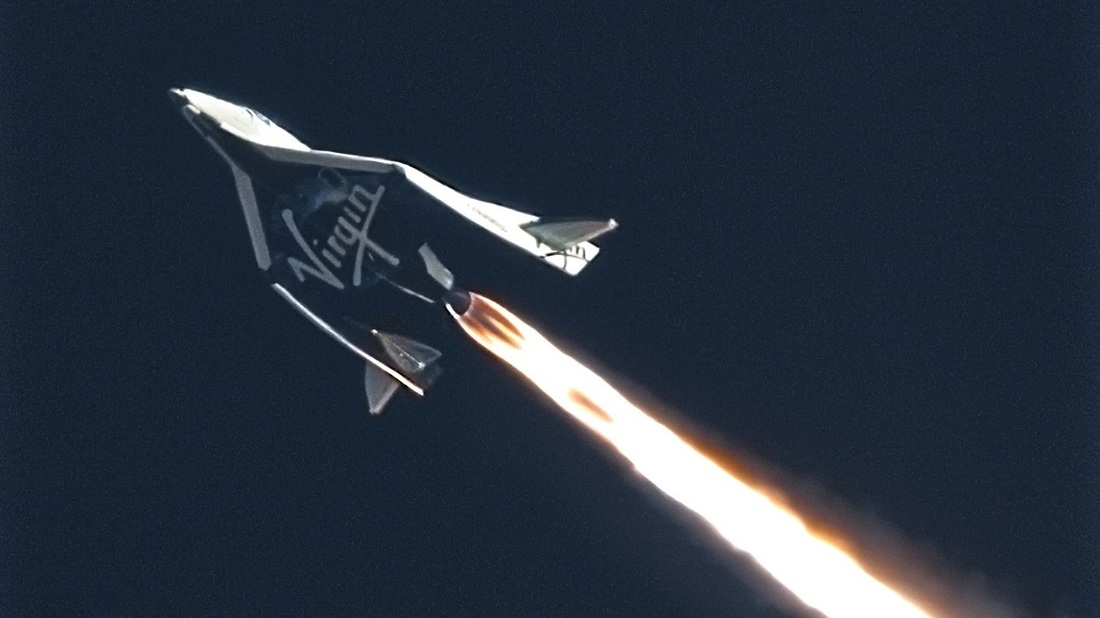
This time last week, by coincidence, I was busy compiling an entry for the Virgin Galactic/Landrover competition to win a sub-orbital space flight on Virgin's Spaceship 2.  However, due to recent tragic events, I noticed today that the competition web page has understandably been suspended until further notice. 

Despite the recent accident, surprisingly I still felt 'up for it' - although I think I would now have great difficulty in persuading 3 of my FaceBook friends to accompany me in the unlikely event that I actually won the competition.

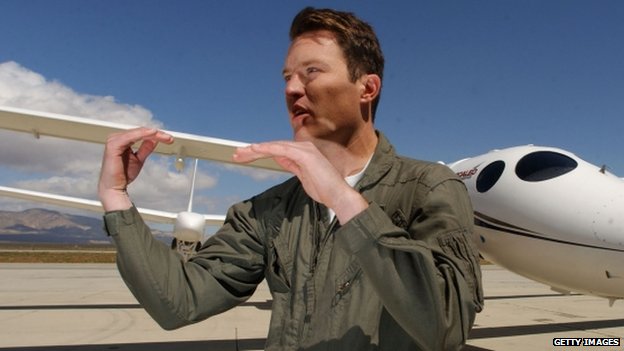
Anyway, this blog post is not about me.  It's just a rather inadequate expression of condolence for the families and friends of the 2 test pilots who were involved in the recent accident, when the vehicle broke up during a rocket powered flight test.  As most of you may know, Mike Alsbury was killed, and Peter Siebold was seriously injured in the accident.  Both were around 40 years old, and married with 2 children.  Although, as test pilots, they were very much aware that their jobs entailed risk, nevertheless this does not soften the blow for their families.  I for one hope that this project continues, and is ultimately successful in being a first small step in opening up the new frontier of 'space' to tourism.  Maybe this vision can be a worthy legasy for Mike Alsbury?

I felt a picture of the vehicle (above) in magnificent flight is much more appropriate than images of debris on the desert floor!
Picture
Mike Alsbury, aged 39, married with 2 children - rest in peace.
0 Comments

Spectacular images from Rosetta's array of imaging cameras.

10/14/2014

1 Comment

 
Picture
The European Space Agency spacecraft Rosetta arrived at Comet 67P/Churyumov-Gerasimenko on 6 August 2014, and has since been in orbit surveying the comet nucleus at close quarters prior to the landing attempt scheduled for 12 November 2014.

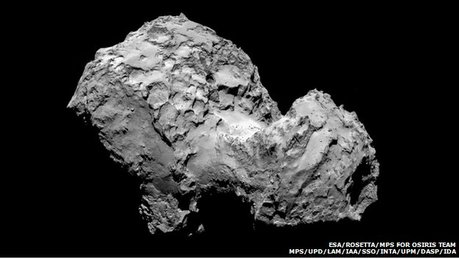
The comet is around 4 km (2.5 miles) in size, and is essentially a 'dirty snowball' comprised of water ice and dust.  The spacecraft has an array of cameras which have been busy producing  high-res images of this amazing object, and pictures taken in September show that the comet is beginning to produce active outgassing/jetting as it responds to the increasing heat of the sun. 

The content of the majority of this post can be found in the 'Picture gallery' page of this website, which shows 12 recent images from the Rosetta spacecraft showing a variety of features of the comet nucleus.  During mid-September images were taken for the purpose of selecting the primary landing site for the Philae lander, and as an outcome of the process 'Site J' was selected as the primary landing site (see Images 4 and 9), and 'Site C' and the backup (see Image 5).  The criteria for choosing Site J were to minimise risk to the lander, while still being scientifically interesting - for example images have shown signs of outgassing activity nearby.  In terms of minimising risk, the majority of slopes in the neighbourhood are less than 30 degrees, and there are few boulders.  The site also provides sufficient solar illumination to provide necessary electrical to the lander's systems.

Finally I should of course acknowledge that all images are courtesy of the European Space Agency.

1 Comment

Rosetta’s orbital strategy prior to landing

10/7/2014

1 Comment

 
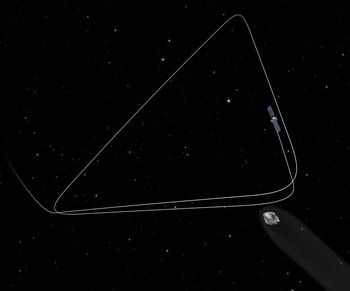
PictureFigure 1. Rosetta's initial 'triangular orbit' around the comet.
Quite a lot of things have happened since I last blogged about Rosetta, so I need to catch up a bit – please see last post below for my excuses and apology!

 As you may know, ESA’s Rosetta spacecraft arrived at Comet 67P/Churyumov-Gerasimenko on 6 August 2014, and the current plan is to drop the Philae lander onto the comet’s surface on 12 November.  Between those two dates, however, a huge programme of orbit manoeuvres has been / is to be undertaken, keeping the operations boys and girls at the European Space Operations Centre (ESOC) very busy.  I’d like to catch-up a bit, by giving a flavour of all this activity leading up to the comet landing in November.


On arrival, the spacecraft entered a rather weird triangular ‘orbit’ around the nucleus in a plane in front of the comet relative to the Sun.  See Figure 1.  Initially the average distance from the comet was about 60 km, and the probe’s speed relative to the nucleus was around 60 cm/sec.  Clearly, this ‘orbit’ was not bound gravitationally to the comet as the escape speed from the very weak gravity field at this distance is very much slower than 60 cm/sec.  So the triangular track was achieved by ‘free-flying’ a hyperbolic trajectory along the triangle’s sides, and performing small thruster firings (< 1 m/sec of delta-V) at the triangle’s corners (see How Spacecraft Fly pages 69-78 for explanation of hyperbolic orbits, and page 173 for information about delta-Vs).  Consequently the triangular sides are not straight lines, but slightly curved due to the gravitational influence of the comet.  By carefully measuring the degree of curvature of the sides of the triangle, an estimate can be made of the total mass of the comet nucleus.  This operation was repeated with a smaller triangular orbit, around 50 km from the comet, in order to refine the mass estimate.  As an outcome of this exercise, the comet’s mass was estimated to be around 10 billion tonnes (1 with 10 zeros) or 10 thousand billion kilograms (1 with 13 zeros).  This was a first step in determining the characteristics of the comet’s gravity field, and an assessment of the volume of the nucleus also gave a density estimate of the order of 300 kg per cubic metre – about 30% of that of water.


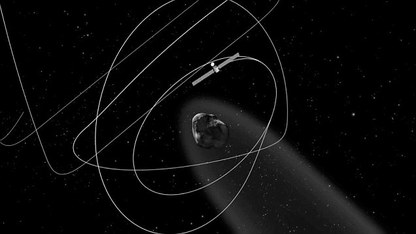
PictureFigure 2. Rosetta's complex orbit strategy prior to landing.
Thereafter the spacecraft entered a circular 30 km by 30 km ‘global mapping orbit’ to further refine knowledge of the gravity field, but also to begin the process of mapping the surface of the nucleus.  The orbital speed in this orbit was around 15 cm/sec.   The transition from the triangular orbit to the mapping orbit was fairly complex – see Figure 2 – but a more helpful insight is perhaps provided by a video animation to be found at:
http://www.esa.int/spaceinvideos/Videos/2014/01/Rosetta_s_orbit_around_the_comet


One of the principal constraints on this exercise was to keep the orbit plane perpendicular to the Sun direction to minimise the ‘drag’ effects on the spacecraft due to outgassing of material from the nucleus.  The 64 square metre solar array would produce the greatest contribution to this perturbation, but the orbit constraint ensured that the array was ‘edge-on’ to any radial flow of material from the comet.

Further manoeuvres are planned to successively lower the orbit – a 20 km by 10 km elliptical orbit, followed by a 10 km by 10 km close orbit in which the orbital speed is around 26 cm/sec.  It is expected that the spacecraft will briefly ‘dive’ to 5 km to drop the lander in November.

If you can’t quite get your head round the orbit strategy, a video presentation by Frank Budnik (a member of the flight dynamics team at ESOC) can be found at:

http://www.esa.int/spaceinvideos/Videos/2014/08/Rosetta_at_comet_First_images_science_results

This was part of the ESOC press presentation on Arrival Day back on 6 August 2014.  The relevant talk is the second in a sequence of presentations.


1 Comment

Chance encounter with a 'rocket man'.

9/24/2014

0 Comments

 
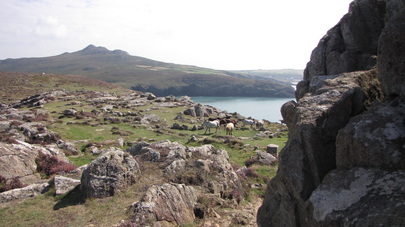
PictureWalking the Pembrokeshire Coastal path (SW Wales, UK).
Firstly, let me apologise to those who follow this blog for not posting recently, especially as so much is happening - in particular the Rosetta mission saga!

A combination of circumstances have inhibited my blogging activity - a hardware problem with my laptop in August followed by a couple of holidays in September.  I am hoping to make up for the deficit in the coming days, but let me say something about my recent holidays - bear with me - it does have some relevance to 'space'. 

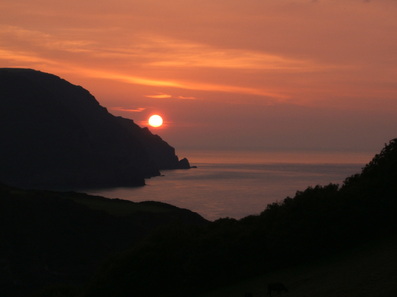
In early September we took a break, walking the beautiful coastal path around Pembrokeshire in SW Wales.  The picture above shows a section of the route near St David's Head.  It was sensational weather for this part of the world, with beautiful settled sunny weather every day during our week's break.  Since I am quite fair skinned I definitely had to take precautions not to burn while out all day in the sun, and this included wearing a sunhat.  The only one I had was a  NASA baseball cap given to me by an American friend who was visiting the Ames Research Centre in the US.  So as my wife and I were taking a rest and some food, another couple wandered by.  The gentleman, clearly american, asked about the NASA cap and we struck up a conversation.   Turns out he worked for NASA as a rocket engineer, being responsible for the Space Shuttle Orbital Manoeuvring System (OMS) engine before the shuttle's retirement in 2011.

PictureThe other holiday break was to the N Devonshire coast, near Lynton UK.
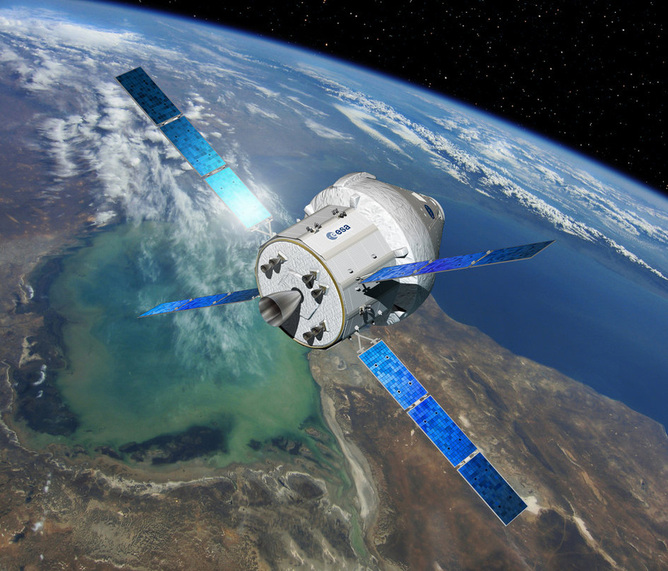
Now he was working on the plan to adapt the OMS engine for use on the new US manned vehicle Orion.  In particular, the current plan is to use the European Automated Transfer Vehicle (ATV) as the Service Module for the Orion capsule, and my newly acquired friend's job was to look at the possibility of integration of the OMS with the ATV - see picture below of the proposed new manned vehicle.  What are the chances of such a meeting in such an unusual setting?!  Anyway needless to say we struck up a very interesting conversation, much to the amusement of our respective wives.   And to add to the long odds, we walked in widely separated locations on the coastal path each day, but somehow we managed to bump into each other on three separate occasions during the week. 

PictureThe proposed US manned spacecraft Orion. The crewed capsule is supported by the Service Module adapted from the European ATV, and propelled by the proven technology of the Shuttle OMS engine.
We both lamented the current state of the US human spacecflight programme, with US astronauts dependent upon Russian goodwill for access to orbit.  And with the current situation in the Ukraine, and the downing of flight MH17, relations with Russia have been stretched almost to breaking point.  Since the retirement of the Shuttle, and the cancellation of the Ares launcher programme by the Obama Administration, US astronauts have had to hire a ride (at a rate of around $60 million/seat) on the Russian Soyez spacecraft.   The US Administration has also proposed extending the lifetime of the International Space Station (ISS) to possibly 2026 (hopefully the US will have an independent means of human access to orbit by then!).

The collaboration between the USA and Russia has been a very healthy one over the years, especially with the establishment of the ISS.  However, this relationship is not just a collaboration - the USA also depends upon Russian space technology in other ways.  For example, the USAF launches classifed payloads (intelligence spacecraft) using Atlas V launch vehicles, which are powered by Russian RD 180 rocket engines.  At the moment there are around 15 of these Russian engines in the american stockpile, and if Russia places an embargo on their future export there could be a few red faces in the US Intelligence Agencies.  Curiously, the US needs Russian technology to spy on Russia!

Time for the Obama Administration to wake up I think, and implement a space strategy that actually makes sense.


0 Comments

Rosetta arrives!

8/6/2014

1 Comment

 
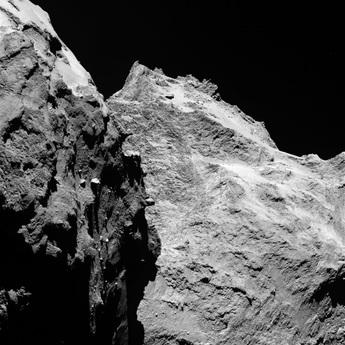
PictureThe comet nucleus imaged on approach.
It's the 6th of August 2014 - a remarkable day in astronautical history as Rosetta has finally rendezvoused with Comet 67P/Churyumov-Gerasimenko.  A thruster burn of 6.5 minutes duration finally brought it to a speed relative to the nucleus of 1 meter/sec, as the process of orbit insertion begins, after a 10 year, 6.4 billion km journey.  The speed of the comet (and the spacecraft) in their shared orbit around the Sun is of the order of 15.3 km/sec.  Transmission time from spacecraft to Earth is about 22 minutes.  The remarkable accompanying images shows that Comet 67P is indeed an irregularly-shaped body, making the task of quantifying its gravity field (prior to the landing in November) an interesting and challenging one.

1 Comment
<<Previous
Forward>>

    Author

    Graham Swinerd - I hope to use this page to highlight current major events in space and spacececraft.

    Archives

    November 2024
    November 2022
    October 2016
    July 2016
    February 2016
    December 2015
    September 2015
    July 2015
    June 2015
    December 2014
    November 2014
    October 2014
    September 2014
    August 2014
    July 2014
    June 2014
    May 2014
    April 2014
    March 2014
    February 2014
    January 2014
    December 2013
    November 2013
    July 2013
    May 2013
    April 2013
    March 2013
    December 2012
    October 2012
    September 2012
    August 2012
    July 2012
    June 2012
    May 2012
    April 2012
    January 2012
    October 2011
    August 2011
    July 2011
    June 2011
    May 2011
    April 2011
    March 2011
    February 2011
    January 2011

    Categories

    All

    RSS Feed

Powered by Create your own unique website with customizable templates.