Please note that ... this blog page is no longer updated.
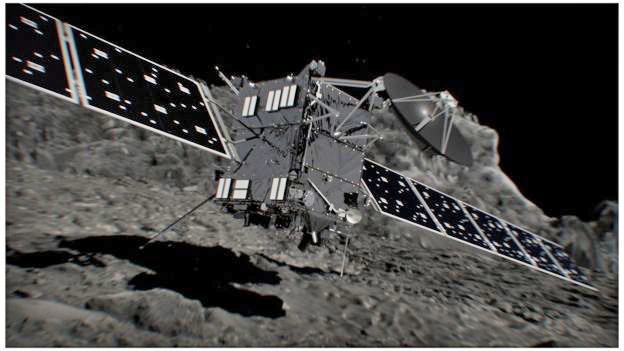 Artist's rendering of what Rosetta's landing may have look like! The 12 year mission of the Rosetta spacecraft came to an end yesterday, 30 September 2016, at 11.19 UT when the Rosetta comet orbiter was crash-landed on Comet 67P. 'Crash-landed' is perhaps a bit of an exaggeration as it was travelling at about walking pace when it impacted the comet's surface. I have to say it has been an absolutely brilliant mission which I have enjoyed at every phase, and I will miss it(!). Congrats and well done to everyone involved in this historic ESA mission! 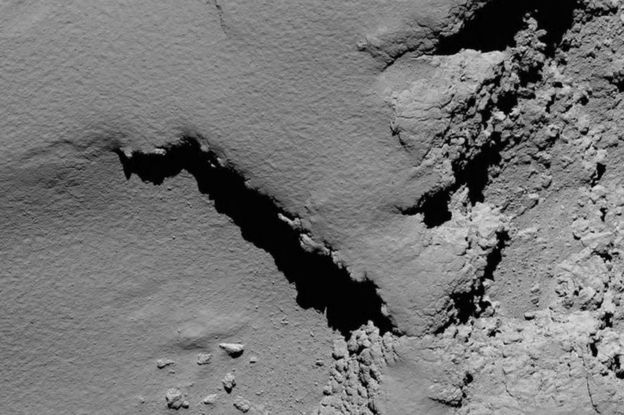 One of the final images returned from the Rosetta spacecraft on its final descent to the comet's surface - this one was taken at about 6 km altitude. 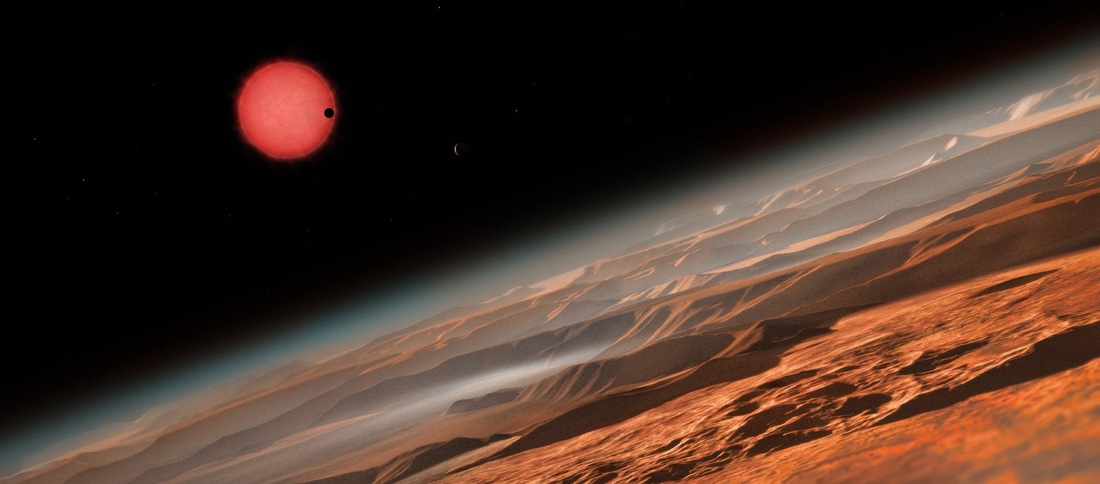 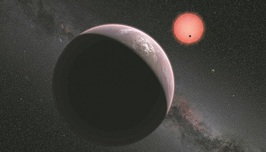 Recently discovered planets around a ‘nearby’ star maybe the home of life. The star is around 40 light years distant in the constellation of Aquarius, and goes by the name of ‘Trappist-1’. The unlikely name comes from ‘Transiting Planets and Planetismals Small Telescope’, which is the telescope system used to discover the planets accompanying this star.
The star itself is a red dwarf, not much larger than Jupiter. Although it is red in appearance, most of its radiative output is in the infrared (heat radiation), outside the visible spectral band. Two of the three planets discovered, going by the names Trappist-1 b and Trappist-1 c, have been shown to be rocky planets about the size of the Earth, with dense, compact atmospheres (not hydrogen). The main feature causing the excitement is that they are believed to be in the so-called Goldilocks Zone – the distance from the central star that is ‘just right’ to allow the existence of liquid water on the planetary surfaces – and therefore potentially life. Another feature of the planets is that they orbit very close to the central star, with orbit periods of 1.5 and 2.4 Earth days, and so will be tidally locked – that is, they would permanently present the same hemisphere to their star. Although the sunny side may too hot and the dark side too cold, nevertheless there is likely to be an intermediate twilight zone where the temperature would be just right to sustain life. If there is intelligent life there, they will have been receiving our radio, television and communications transmissions for some years. Just now they will be hearing about events down here on Earth around the year 1976. In the UK, the media was full of summer heat and drought, the ‘punch-up’ with Iceland over fish, and Barry Manilow and ABBA were popular in the charts. Apparently among the top-rated TV shows then were ‘Happy Days’ and ‘Charlie’s Angels’. Based on the stream of media output from those times, I wonder if they would judge there to be intelligent life here? 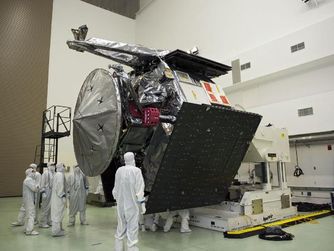 After a 5 year journey, the Juno probe entered orbit around Jupiter in the early hours of this morning (5 July 2016). Launched on 5 August 2011 (see blog post 8/8/2011), the spacecraft weighed in at about 3.5 tonnes. After a complex journey involving an Earth swing-by and 2 primary deep space manoeuvres, Juno’s Jupiter Orbit Insertion (JOI) burn began at 4.18 BST (3.18 UT) on 5 July 2016 at an altitude of 4,200 km above the 1 bar surface of the giant gaseous planet. Since Jupiter does not have a definite surface, this height is expressed in kilometres above the Jovian atmospheric surface where the pressure is equal to the atmospheric pressure at the Earth’s surface. The burn lasted the planned 35 minutes – the British built thruster performed flawlessly – which slowed Juno’s speed by 480 m/s. This change in speed (delta-V) was sufficient to allow Juno to be captured by Jupiter’s gravity field and inject it into a large and very elongated elliptical orbit. As the mission progresses, the height and shape of this initial orbit will be trimmed by further thruster firings. A consequence of this manoeuvre was that the spacecraft plunged deeper into Jupiter’s trapped radiation belts (analogous to Earth’s Van Allen Belts) than any spacecraft prior. A significant design feature of the spacecraft is that it requires to be heavily radiation-hardened, as the total radiation dose it will receive during the mission will be around 10 Mrad – sufficient to fry the electronics of a typical Earth orbiting spacecraft. 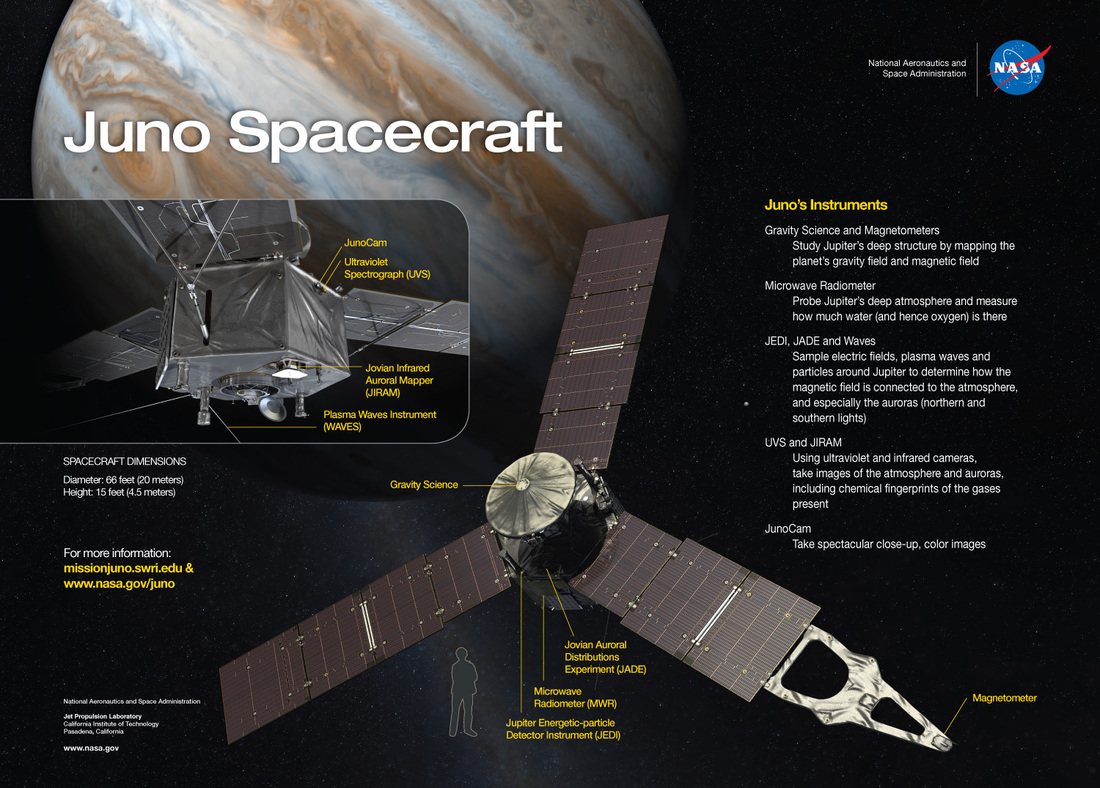 Details of Juno's payload instruments - Source NASA 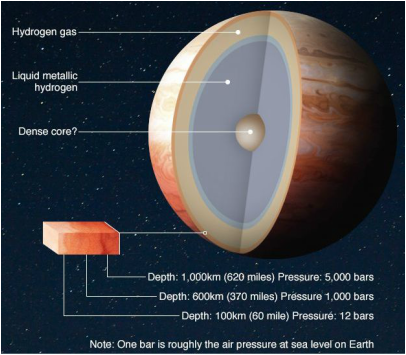 Current assumptions about Jupiter's internal structure - Source NASA Current assumptions about Jupiter's internal structure - Source NASA Juno is not the first spacecraft to orbit Jupiter – the Galileo spacecraft entered orbit in 1995. However, Galileo’s principal mission was to explore Jupiter’s host of moons, which it achieved spectacularly well before plummeting into Jupiter’s atmosphere (deliberately!) in September 2003. Unlike Galileo, Juno’s main mission is the study of Jupiter itself, and to do this it has an array of instruments to accomplish this (see image summarising payload). The primary instruments will investigate the planet’s gravity field, magnetic field, radiation belts and atmospheric composition, as well as imaging the dynamic atmospheric surface below. One of the main objectives is to study the planet’s internal structure (see image), and this is done indirectly by mapping Jupiter’s gravity field very precisely. The investigators use the spacecraft’s communication system to determine the probe’s orbit to high accuracy. The method, referred to as Doppler ranging (see video), produces a position accuracy of about 1 metre. The short period changes in the spacecraft position and speed allow the gravity field to be mapped, and this in turn reflects the variations in density and structure internally of the planet.
This is just the beginning of the Juno mission – to keep abreast of new developments go to the NASA Juno website: https://www.nasa.gov/mission_pages/juno/main/index.html 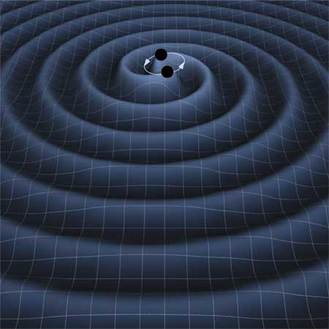 Way back in the ‘dark ages’ – well actually about 40 years ago – as a young man I graduated with a PhD in mathematical physics. As I’m typing, I’ve just got a rather dusty copy of the thesis off the shelf in my office to try to remember what the exact title of the dissertation was – “The theory of high frequency gravitational radiation and its application to cosmology”. Basically I enjoyed 3 years of my young life researching Einstein’s great achievement, the general theory of relativity, and applying the rather esoteric mathematics to the topic of gravity waves. At that time, gravitational waves and cosmology were rather theoretical sciences. Cosmology had only recently adopted the Big Bang theory, as a consequence principally of the discovery of the microwave background in 1964 which was soon accepted as the after-glow of the creation event. Although I had a great time mastering the mathematics of gravity waves, it was appreciated at the time that their experimental detection was way beyond the any observational capabilities available at that time. However, more recently, with the huge improvements in the precision of our observational technology, cosmology in general has come of age, becoming a hugely successful ‘experimental science’. As a consequence, an army of researchers over decades have pieced together a credible picture of the creation of the universe, and how it has subsequently evolved to give the beauty and diversity of the structures – galaxies, stars, planets – that we now see. Clearly there are still many issues to resolve (what happened at time zero to start it all? what is the nature of dark matter and dark energy? do we live in a multiverse? … and so on), but then that’s the nature of scientific progress. Resolutions and answers always lead to more questions. 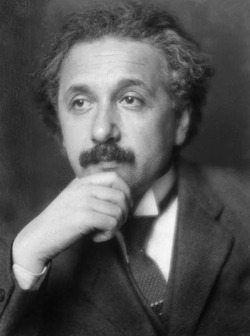 Anyway, getting back to gravity waves, these were first ‘discovered’ by Albert Einstein in a paper published in 1916 (Einstein, A., Annalen der Physik 49, 769-822 (1916)). His general theory of relativity (which I shall refer to simply as Einstein’s gravity theory) was published the year before, and Albert was in the process of exploring his new theory. However, as is commonly known (I think?) Einstein’s gravity is described by notoriously complex equations. In an attempt to simplify the math, Einstein used something called a ‘linear approximation’ to examine the theory and in the process found a ‘wave equation’. I don’t know if that makes sense to anyone, but all it means is that he had discovered that the theory predicted ripples in the fabric of space and time that propagated at the speed of light. Gravity wave theory was born! The situation is similar to the discovery by James Clerk Maxwell, a Scottish mathematical physicist, of a wave equation in his theory of electromagnetism 50 years earlier. Maxwell’s theoretical discovery led to our current understanding of light, and the spectrum of electromagnetic radiation from long wavelength radio waves to very short wavelength X and Gamma rays. Interestingly, because of the use of the approximate technique in his 1916 paper, Einstein had long-term doubts about whether gravity waves actually existed in reality – but recent events have of course shown them to be real, and you can almost imagine that wise old face looking down on us with a broad smile. 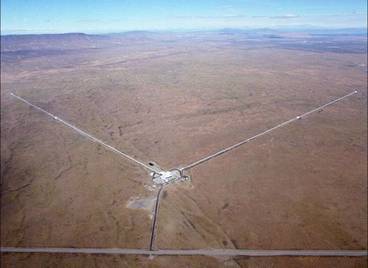 Aerial view of the LIGO system. Each 'arm' is 4 km in length. Aerial view of the LIGO system. Each 'arm' is 4 km in length. So what are gravitational waves? According to Einstein's theory, any accelerating mass will produce propagating waves in the medium of space and time. So if you jump up and down and wave your arms about, you will become an emitter of gravitation waves. However, the effect is very weak, so only large masses, encountering very large accelerations, are expected to warp their surrounding space-time to any appreciable degree. Throwing a stone into a perfectly calm lake gives a reasonable, intuitive picture of gravitational radiation. The initially flat surface is disturbed, and concentric waves in the curvature of the 2 dimensional surface propagate outward from the splash. However, with gravity waves we have to notch the dimensions up by 2 to envisage a propagating disturbance in the curvature of 4 dimensional space-time, making it a little more difficult to get your head around! 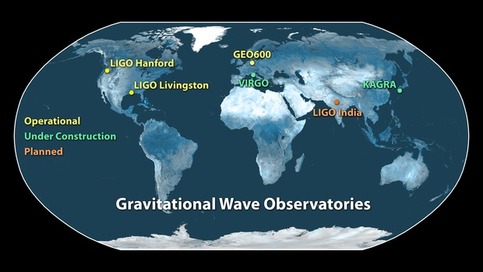 Global distribution of gravity wave detectors Global distribution of gravity wave detectors So what happens when a gravity wave passes through the Earth? The space-time we occupy is periodically squeezed and stretched as the wave passes, but this distortion must of course be very small or otherwise we would have noticed it long ago. Theoretical studies indicate that the disturbance would be expected to be no bigger than a fraction of the width of a sub-atomic particle – a shockingly small effect that posed a huge challenge to the scientists and engineers developing detectors to observe it. Over the last few decades systems designed to detect gravitational waves have been developed, but with little success. But then in the last decade or so, two LIGOs (Laser Interferometer Gravitational-wave Observatories) have been developed and refined in the USA at widely separate locations, one at Hanford in Washington State and the other in Livingston in Louisiana – about 3000 km apart (see video). These systems are effectively 2 detectors working in unison as one observatory. Each LIGO is effectively a laser interferometer, where a high-power laser produces a light beam which is divided by a beam splitter. Each beam is then directed at right angles to each other down two 4 km long evacuated tunnels that are arranged in an L-shaped configuration. The two beams are then bounced back and forth by mirrors, before eventually returning to their starting point. If the passage of gravity waves has disturbed the curvature of space-time in the observatory there will be a difference in the length of the light paths of the two beams, which is estimated by analysis of the interference between the beams in the detector. Expressed in this way, I think the process sounds fairly straightforward. However, the main issue for the designers was to manage the amount of ‘noise’ in the system, given that the strength of the ‘signal’ was expected to be so small. Although every effort was made to isolate the detector’s elements from the general drone of planet Earth (e.g. the force of the wind, the vibration of a passing lorry, seismic events, and so on), nevertheless the signal was still buried in a sea of noise. So techniques were required to aid in the uncovering of any tiny gravity wave signal present. The main means of doing this was to trawl the noise looking for specific patterns representative of what we expect gravitational wave signals to look like. Many years of research involving supercomputer solutions of Einstein’s gravity theory equations have allowed us to predict the expected LIGO signal for a variety of astrophysical events. In other words, the wave signal has specific tell-tale frequencies and characteristics. The video is quite old, but explains well the principle of laser interferometry s The signal confirming the existence of gravity waves was received at 10.51 UT (GMT) on 14 September 2015. In the subsequent 5 months, prior to the announcement of the discovery in February 2016, an army of researchers from 80 institutions in 15 countries exercised their expertise to work out what it was that LIGO had actually detected. And the details of what it ‘saw’ are completely staggering! For me this was definitely a ‘wow!’ moment. There are so many occasions in recent times when new discoveries have been made on the frontiers of science, and what we have found in nature is way beyond anything we imagined. For me, this is one of those occasions. Quoting the Executive Director of the LIGO, David Reitze - "Take something about 150 km in diameter, and pack 30 times the mass of the Sun into that, and then accelerate it to half the speed of light. Now, take another thing that's 30 times the mass of the Sun, and accelerate that to half the speed of light. And then collide them together. That's what we saw here. It's mind boggling." Basically he’s describing two monster black holes spiralling around each other, getting closer and closer to each other due to the huge amount of orbital energy being lost in the form of gravitational waves. One has a mass of 30 solar masses (1 solar mass = the mass of our Sun) and the other about 35 solar masses. In the moments just before they collide and coalesce they are orbiting each other several tens of times per second. At the moment when their event horizons merge, and they become one, the event produces a pulse of pure radiate energy in the form of gravitational waves equivalent to 3 solar masses (E equals m c squared!). And it is the huge energy of this pulse that allowed the LIGO systems to detect the event, even though the black holes were roughly 1.3 billion light years away. To put this pulse of gravity wave energy into perspective, the mass equivalent of the Sun’s radiant energy released over its lifetime of about 4.6 billion years is a mere 0.00031 solar masses, and the mass equivalent of the energy released in the brightest supernova explosion yet observed is roughly 0.006 solar masses. Extraordinary! The video shows a simulation of the merging of two orbiting black holes - the kind of event observed by LIGO. The surface beneath gives a 2D representation of the corresponding warping of the surrounding 4D space-time. In the diagram below, the output from the Washington State detector is shown in orange, and that of the Louisiana detector in blue. The detector output predicted by Einstein’s gravity theory is also shown by the finer line. The correspondence between the signal predicted by theory, and that which was actually observed is remarkable. Also the signal was seen in both LIGO systems at virtually the same time, the small delay in detection between them being explained by their 3000 km separation. In the past, we have detected gravity waves by indirect methods – for example, by measuring the loss of orbit energy of compact binary systems and comparing it with the expected energy of gravity wave emission (see blog post on September 1, 2012), but this is the first time they have been detected directly. 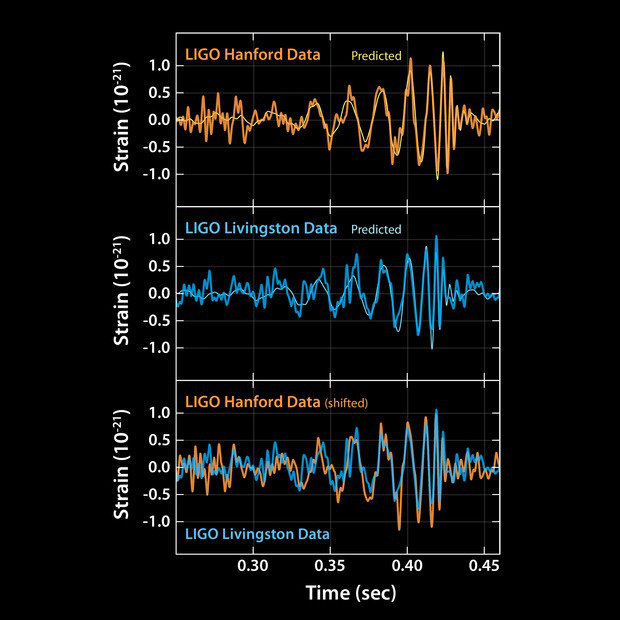  Why is it important? – or, as my wife would say, “what’s that got to do with the price of fish?” (no idea really where that came from – why the ‘price of fish’?). Getting back to the matter in hand – it comes down to the electromagnetic spectrum versus the (newly discovered) gravitation radiation spectrum with respect to their utility in astronomical research. Our current understanding of the Universe has been acquired solely through the window of the electromagnetic (em) spectrum. Since the year dot, we have exploited all parts of this in our astronomical investigations of the cosmos, and in doing so, we are aware that em radiation can be absorbed and scattered by its interaction with matter. Hence the view through the em window has its limitations. Gravity waves, on the other hand, do not suffer the same obscuration, as they pass freely through material objects. I have no idea what a future ‘gravitational wave telescope’ might look like, but it is possible to think of using such technology to probe even the creation event at time zero when space, time, mass and energy burst into existence. However, we do have an awfully long way to go before such a pipe dream becomes a reality, if at all! 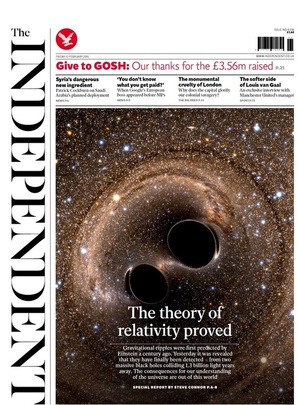 To finish on an amusing note – well , I found it amusing anyway – Albert Einstein again found himself on the front pages of the newspapers. This in itself was not what I found amusing, but rather the accompanying headlines and news copy – for example, the lovely headline on the front page of the UK newspaper The Independent: ‘The theory of relativity proved’. Einstein’s gravity theory is wonderful in providing detailed predictions of how macroscopic systems (involving large masses and high velocities) work, but as the majority of professional scientists, and indeed many amateur scientists know, when the theory is applied at quantum scales it breaks down. And indeed this is not a minor issue with Einstein’s theory – truths about mysteries such as what happens at the centre of a black hole, or what happened at ‘time zero’ in the Big Bang cannot be uncovered with this limitation to the current theory. The unification of Einstein’s gravity and quantum theory is a huge challenge for the physics community at present, and it has been so for the last 6 or 7 decades. Until such is resolved, we cannot consider the theory of relativity to be proven! On a more philosophical note, the person who wrote the headline clearly does not have a grasp of how the scientific method works – fundamentally, a theory cannot be proven, but only falsified. Einstein’s theory has been around now for just over 100 years, and in that time it has been tested against reality time and again, and remarkably it has not been found wanting. However, with the increasing precision in our observational technology, it’s entirely possible that someone will make an observation of the real world in future years which will not be in accord with the theory, in which case Albert Einstein will suffer the same fate as Isaac Newton before him. His theory will have been falsified and physicists will have to go back to the drawing board to start again. It’s just the way science works.
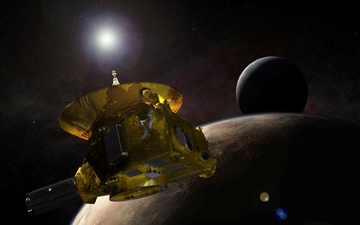 The process of downlinking the contents of the New Horizons spacecraft's onboard digital storage continues, after its close encounter with the Pluto system on 14 July 2015. As we have noted before, this will continue throughout 2016, so there are still plenty of surprises waiting to be revealed by this amazing little spacecraft. This post shows just a couple of the hi-res images recently released by NASA, but if you want to see more data/images/videos please go to: http://pluto.jhuapl.edu/Multimedia/index.php 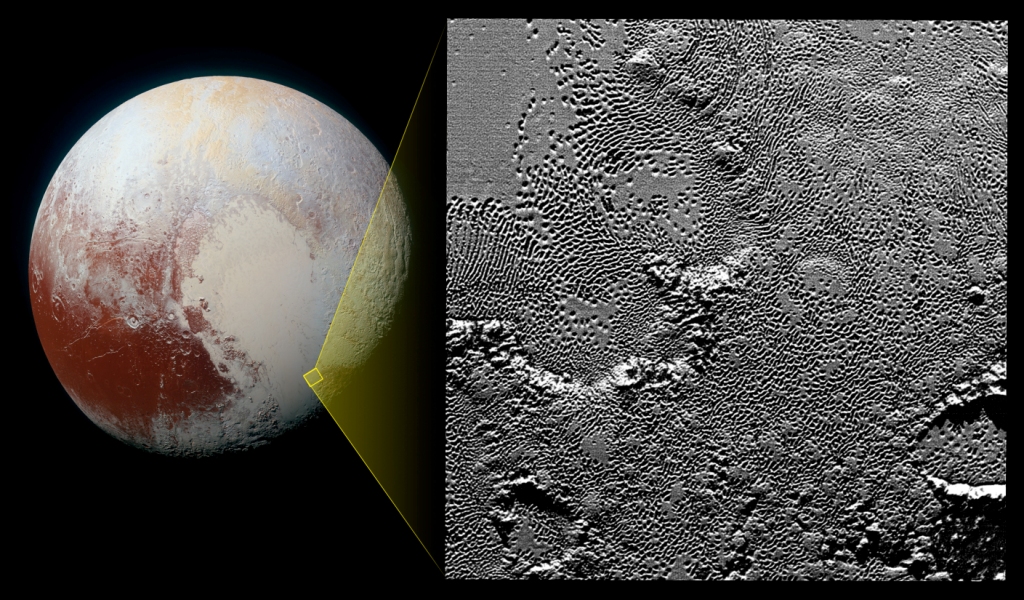 The above image was taken on 14 July 2015, just 13 minutes before closest approach to Pluto, from a range of around 9,550 miles. The framed area is about 50 miles square, showing underlining ancient crater-like features. Super imposed upon this is a huge number of younger pitted features, each around 100s of yards across by 10s of yard deep. It is believed that the pits have been formed by some form of surface process, rather than by external impacts  This image was taken on 14 July 2015 just 15 minutes before closest approach to Pluto from a range of around 10,000 miles. The 'ground scale' is about 50 miles across the image, and shows a mountain/plain boundary. The mountains are believed to comprise water-ice blocks about 1.5 miles high, which fall to a boundary with a plain of nitrogen-rich ices. The plain is predominantly flat with a cellular structure.
 As Philae approached touchdown on Comet 67P on 12 November last year, one of the tiny lander's camera systems took a sequence of 7 still images between 67 m and 9 m altitude. These images have now been blended into the continue video sequence shown below. At 9 m altitude the image resolution is just less than 1 cm per pixel. As you may recall, this was the primary landing site but all the anchoring systems failed on touchdown. As a consequence, Philae 'bounced' and ultimately came to rest in an inhospitable location which curtailed surface operations (due to lack of solar illumination and low temperature) to a short 3 days or so.  Proposed US manned vehicle Proposed US manned vehicle I was amazed to read recently of the 'new schedule', announced by NASA, for the first manned flight of the Orion system. Now they are proposing a first flight in 2023 - 8 years from now! Recently I've been reading a great (old) book called 'Flight' that I recently discovered by Chris Kraft about the early days of the US manned space program. I couldn't help contrasting what was happening then, and what's going on now. Chris's account was full of pace, urgency and excitement as it recounted his experiences of the Mercury, Gemini and Apollo eras. I know there was political incentives then to beat the Soviet Union to the first footsteps on the lunar surface. But despite this, I still find the slow pace of the current efforts incredible.  Of course, it's not all down to the US, as the new vehicle's development now involves the Europeans. Europe role is to adapt the ATV system so that it can operate as the 'service module' - see above image. However, to deny that there are not similar political pressures these days is a mistake. I think it's likely that Chinese astronauts (taikonauts?) will already be on the lunar surface when Orion undertakes it's first manned test!
And is the fact that US astronauts are reliant on Russian launchers for access to the ISS, and orbit in general, an acceptable state of affairs? You're kidding - right ...? Time for the US administration to wake up and inject a little impetus, and the necessary funding, into the manned program to recapture national pride, and leadership in the arena of manned space exploration!  Since close approach of New Horizons to the Pluto system on 14 July the ground segment has been busy gathering image and science data from the spacecraft as it races away, ultimately to leave our Solar System. Although the data received so far represents only a small fraction of the total stored onboard, it nevertheless has wetted the appetite of the science team on the ground. As I said in my flyby preview blog (11 June 2015), it's going to take until nearly the end of next year to download all the scientific treasures, but here is just a small sample of some of the findings to date. 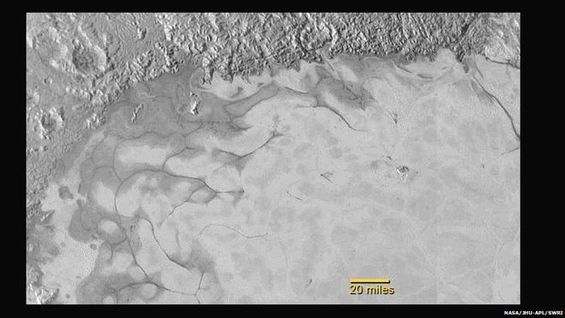 The following three images show hi-res close-ups of Pluto's surface. The surface features in some regions looks very alien and devoid of familiar landforms, making it difficult to interpret and to appreciate scale. The image to the right and below show ice covered plains - but not necessarily comprised of water ice. With an average surface temperature of -230 degrees Celsius, they are more likely comprised of frozen gaseous deposits of nitrogen, methane and carbon monoxide. The third surface image shows a mountainous region in Pluto's southern hemisphere. 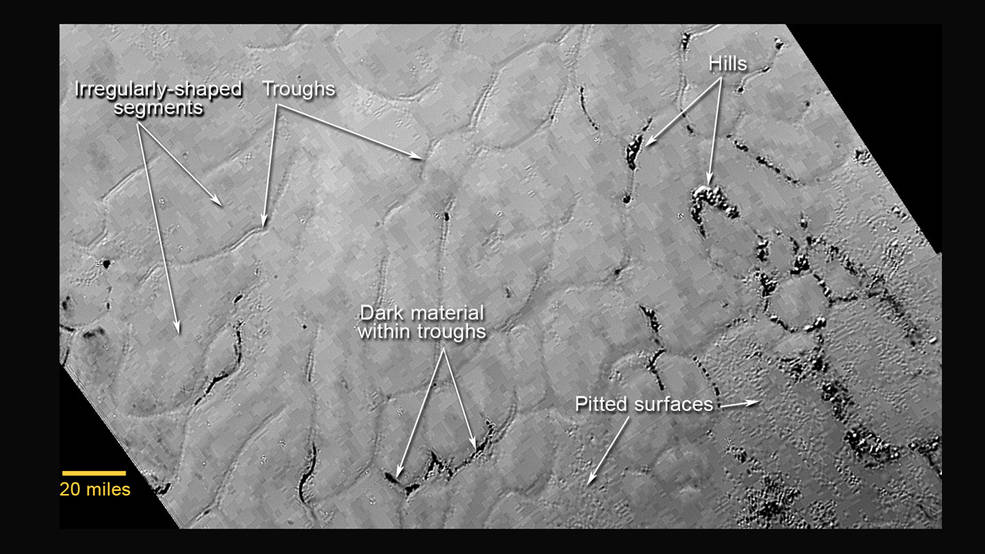 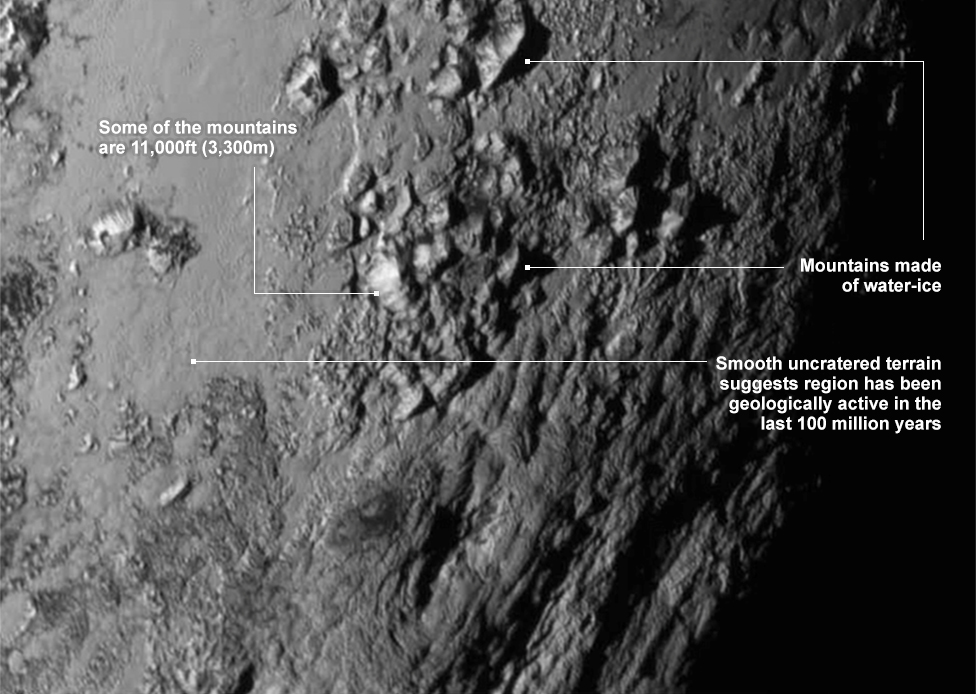 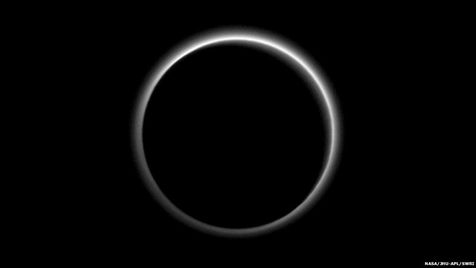 During the encounter, the spacecraft 'flew' into Pluto's shadow to produce this rather splendid picture of a Plutonian solar eclipse. Scientifically this was a very valuable thing to do, as the planet's atmosphere (if it had one) would be backlighted by the Sun allowing measurements to be made of its structure and composition. Prior to the New Horizon's mission it was anticipated that Pluto might have an atmosphere. It was believed that when Pluto was closest to the Sun, surface ices would vapourise to produce an atmosphere, and then when it was at its greatest distance from the Sun, the atmosphere would freeze and collapse again onto the surface. Pluto's orbit is very elliptical, so when it is its closest to the Sun (perihelion) it is 30 AU from the Sun ( 1 AU = 1 Astronomical Unit = the mean Earth-Sun distance), and when at furthest distance (aphelion) it is 49 AU away. So Pluto's orbital position makes a big difference to the solar input. Currently Pluto is at about 33 AU from the Sun, and so fairly close to perihelion and maximum solar input, causing the atmosphere that can be seen in the image. However it is extremely tenuous - onboard sensors have measured a pressure of just a few millionths of the pressure here at Earth, with the composition being predominantly nitrogen, methane and carbon monoxide. The images below show some of the features on Pluto's major moon Charon. 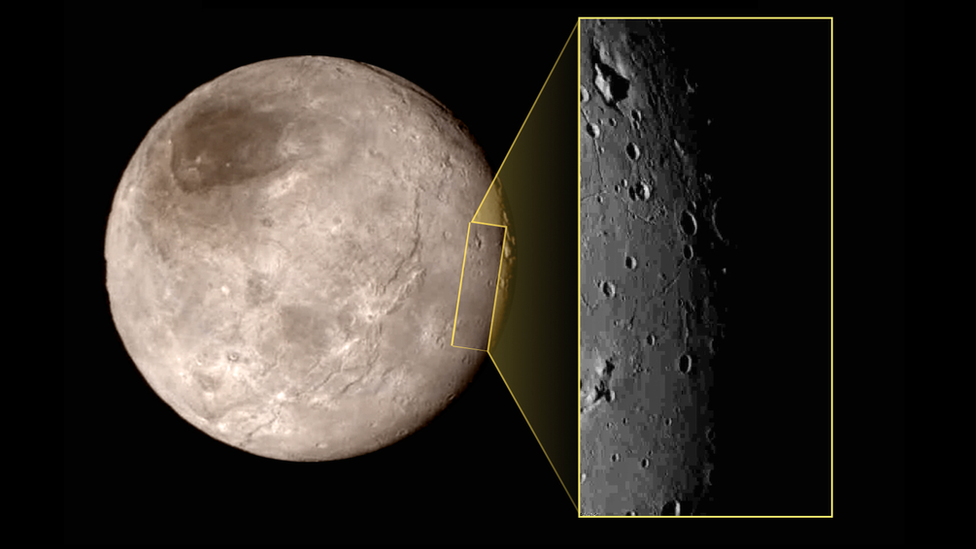 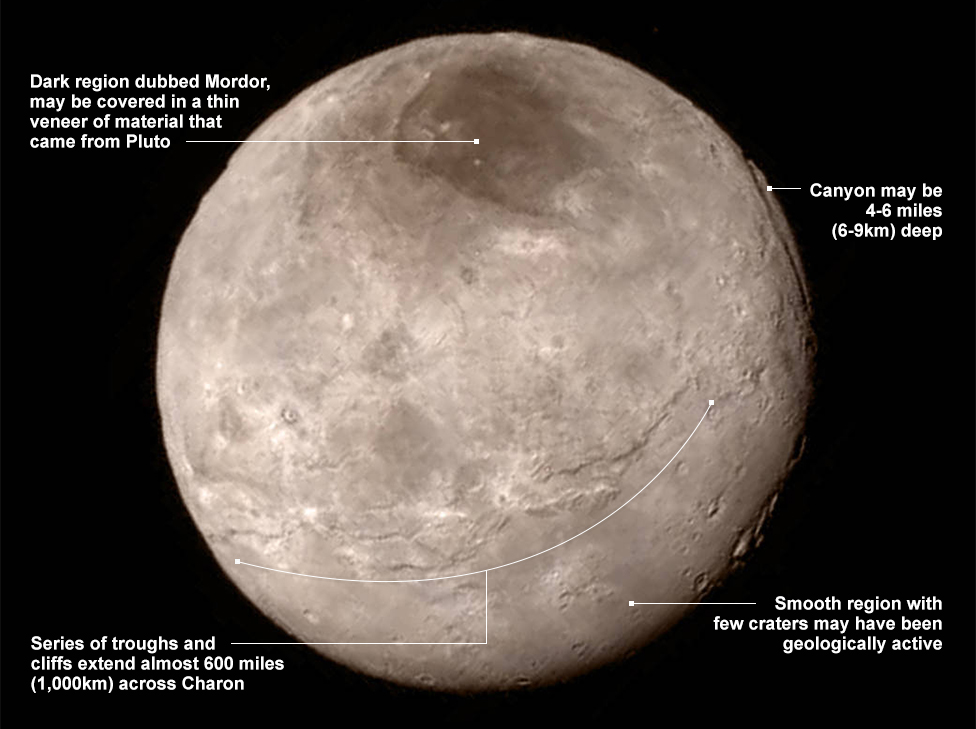  Lots of happy New Horizons team members after Pluto encounter yesterday (14 July 2015) Lots of happy New Horizons team members after Pluto encounter yesterday (14 July 2015) Well, the new Horizons spacecraft appears to have achieved a successful flyby of the Pluto system yesterday with much celebrating at mission control in Maryland USA. However, as the close encounter was controlled autonomously, we will have to wait a while to see if all the data and image gathering tasks were performed correctly. But so far all looks good, with the spacecraft re-establishing a telemetry link with the ground today (Wednesday 15 July 2015), indicating the the spacecraft is healthy after its close approach. Prior to this the spacecraft was able to transmit some hi-res images, a couple of which are shown below. Watch this space for more revelations over the coming days! 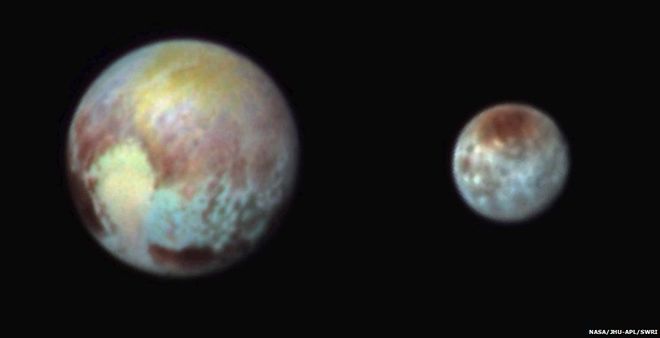 The 'double planet' - Pluto (left) and its major moon Charon 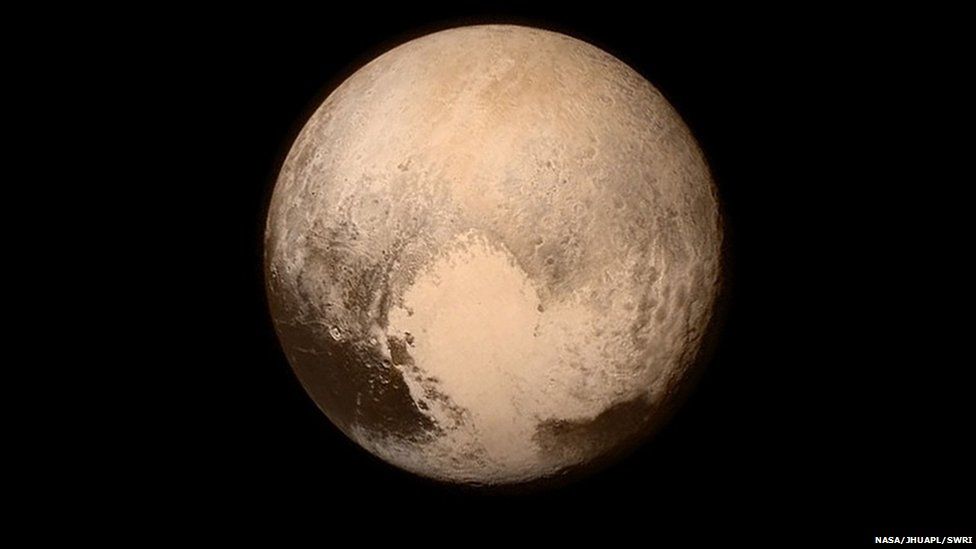 First hi-res image of Pluto prior to closest approach - the definition of surface features is not great with the Sun illuminating Pluto from behind the spacecraft. |
AuthorGraham Swinerd - I hope to use this page to highlight current major events in space and spacececraft. Archives
November 2022
Categories |
 RSS Feed
